
This Week In Ag #115
What better way to celebrate #NationalStrawberryMonth than by visiting my good friends George & Susan McDonald, owners of Catesa Farms, in middle Tennessee. George says that strawberries are grown with one of two goals in mind: shelf life or taste. He opts for the latter. My taste buds agree – their berries taste too good to be legal!
George does not sell his fresh strawberries to grocery stores. He sells directly to consumers from his farm and to local restaurants. His “grown for taste” philosophy does have a compromise. You need to eat, freeze, or make jam (thankfully, my farm girl wife excels at this) within about three days, because they have little shelf life.
The traditional commercial operations found in California (which produces over 90% of all US-grown strawberries), Florida, and Mexico focus on shelf life for their large retail grocery store customers. Once picked, they typically take about three days to ship across the country and have a shelf life of about one week.
For those concerned with carbon footprints, strawberries are a great example of the need to support local farmer markets and develop local food systems. Not only does locally grown produce offer incredible taste, but it also dramatically slashes freight distances. But there’s no denying Americans love this wedge-shaped red fruit, which on average they consume at a rate of 5.5 pounds per year.
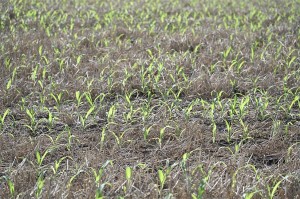
Last year, I planted corn on May 1, and it was up in five days. This year, I planted on May 6 and five days later… still no corn emerged. How could that be? In a word: heat. Or more specifically, the lack thereof.
You see, when it comes to crop emergence, it’s not really about days, but Growing Degree Days (GDD). Soil temperatures must be 50 degrees, and the kernel must absorb 30% of its weight in moisture for corn to germinate (or spout). But to emerge above the 2 inches of soil it’s planted in, corn relies on a heat index called Growing Degree Days. Corn needs about 120 GDDs to emerge.
GDDs are calculated by adding the day’s high and low temperatures, dividing by 2, and subtracting 50 (for calculating purposes, 86 degrees is the maximum, 50 degrees is the minimum). Last year, on the day I planted, we hit 88 degrees for a high and 65 for a low, which gets us 26.5 GDDs. This pattern continued, which brought my corn up on the morning of day 5.
This year, it’s been much cooler. In the first five days since my seeds were planted, we’ve only accumulated 83.5 GDDs. Based on the forecast, I should see corn spike mid-week.
I must admit, since moving to the South, I’ve gotten spoiled when it comes to crop emergence. Usually, an abundance of warm sunny days brings crops up in a matter of days. Back in Illinois, it was not uncommon for corn to sometimes take about two weeks to emerge.

Related Posts
This Week in Ag #43
December 8th is #NationalChristmasTreeDay. This of course sets up the great debate, real or fake? While every family weighs the pros and cons of choosing the Tannenbaum they rock around, a popular nation is that fake trees are more eco-friendly. After all, they can keep for many years, right? And isn’t it bad to cut down real trees merely for decoration? Not so fast.

A Farmer’s Fourth of July: The Fireworks Waited
This Week In Ag #122: A Farmer's Fourth of July: The Fireworks Waited For many Midwest farm families, the Fourth of July wasn’t about fireworks or cookouts—it was wheat harvest season. In this personal reflection, Fred recalls a time when the combine came first, soybeans followed close behind, and the only bangs came from the grain bin, not the sky.
This Week in Ag #83
Grandpa Fred never saw me. Despite the fact I was at his house nearly every day for over two decades. That’s because he was blind. From a farm accident. An anhydrous hose burst and shot the gas in his eyes.