
Huma Gro® products with Micro Carbon Technology® offer an unsurpassed level of application efficiency, allowing farmers to grow more with less fertilizer input. Growing more with less lowers input costs and maximizes return on investment. It also decreases the amount of N-P-K residues that can negatively impact the environment.
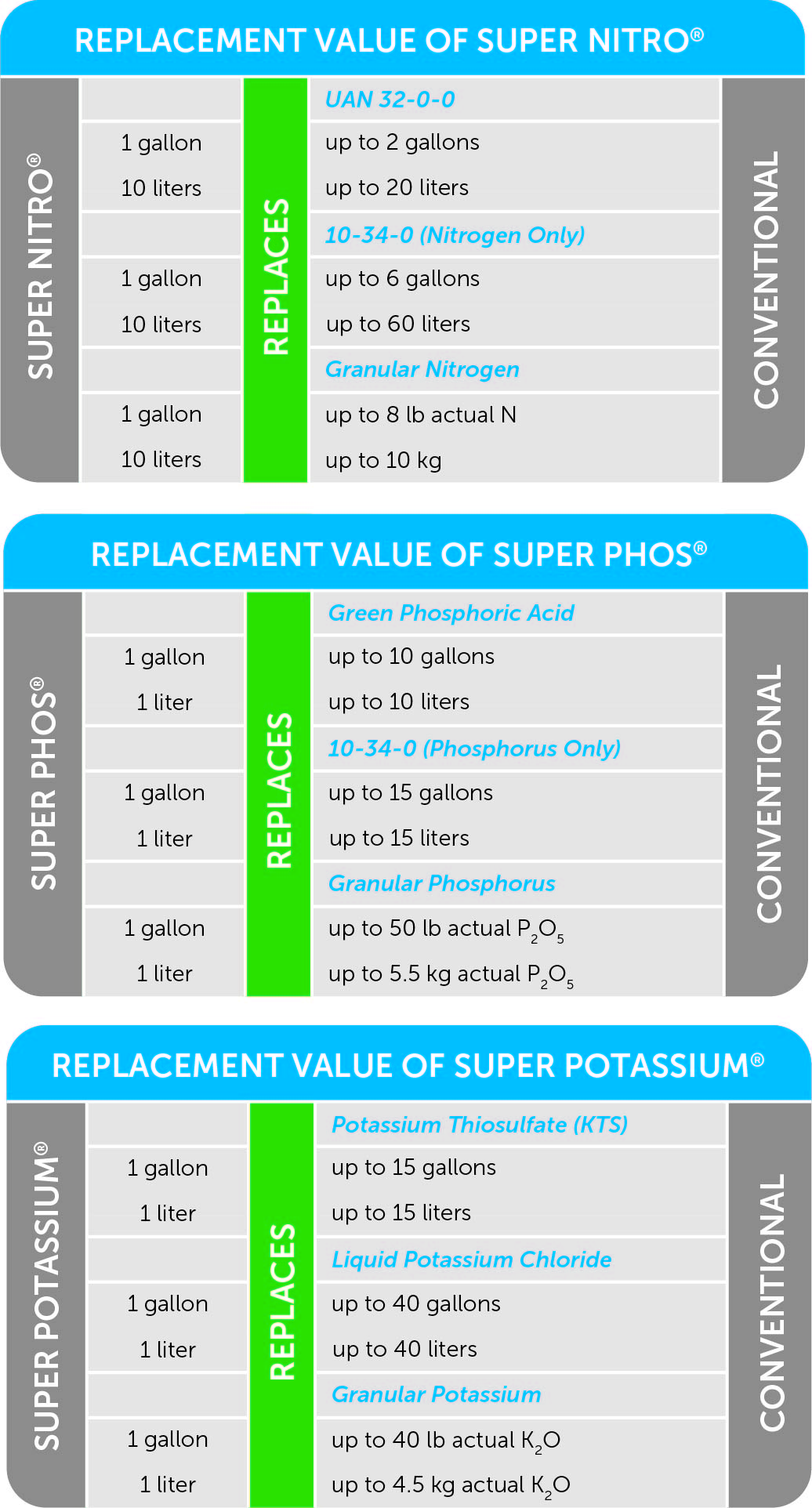 Just how effective are they? The graphic shows the standard efficiencies achieved when specific Huma Gro® liquid products replace conventional fertilizers:
- 1 gallon of Super Nitro® replaces the nitrogen component of 6 gallons of 10-34-0.
- 1 gallon of Super Phos® replaces the phosphorus component of 15 gallons of 10-34-0.
- 1 gallon of Super Potassium® replaces up to 40 gallons of liquid potassium chloride.
And there is more value to be had:
- Ultra-concentrated, low-salt-index liquid formulations mix well with other nutrient solutions, PGRs, and pesticides.
- All products can be foliarly applied, without risk of leaf burn, for immediate nutrient uptake.
- All products can be soil-applied, using any irrigation system, without risk of tie-up. Nutrients remain stable and available in the root zone.
How well do these products work in the field? Here are some examples:
- Super Phos® on Corn 15x More Efficient Than Conventional Phosphorus (10-34-0)
- Super Phos® Applied at 1/8 Rate of Conventional Phosphorus Improves Soybean Yield
Read the full N-P-K brochure.

Related Posts

Evaluation of Micro-Carbon Technology-Based P Fertilizer, SUPER PHOS®, in Spring Wheat

HUMA GRO® ZAP® CAULIFLOWER TEST FIELD IN SPAIN
Distributor: Huma Gro Hispaña HUMA GRO® application was ZAP® 5L/ha The cauliflower on the left was planted 3 weeks earlier than the cauliflower on the right, meaning the control is an older crop—although it looks worse for wear and is shorter. The two groups have equal nutrition programs: the difference is time and ZAP® at 5L/ha.

Are you Growing Brilliance Strawberries? Planting Requirements and Nutritional Needs for Florida Strawberries
An interview with Jason Garcia, Huma Gro® Regional Manager and Agronomist By Jael Batty In August, Florida strawberry growers will begin laying plastic for the next season. Planting starts in September/October and harvest extends from December to early April. After the strawberry season, growers are double-cropping with watermelon, bean crops, or vegetable crops. In the following