
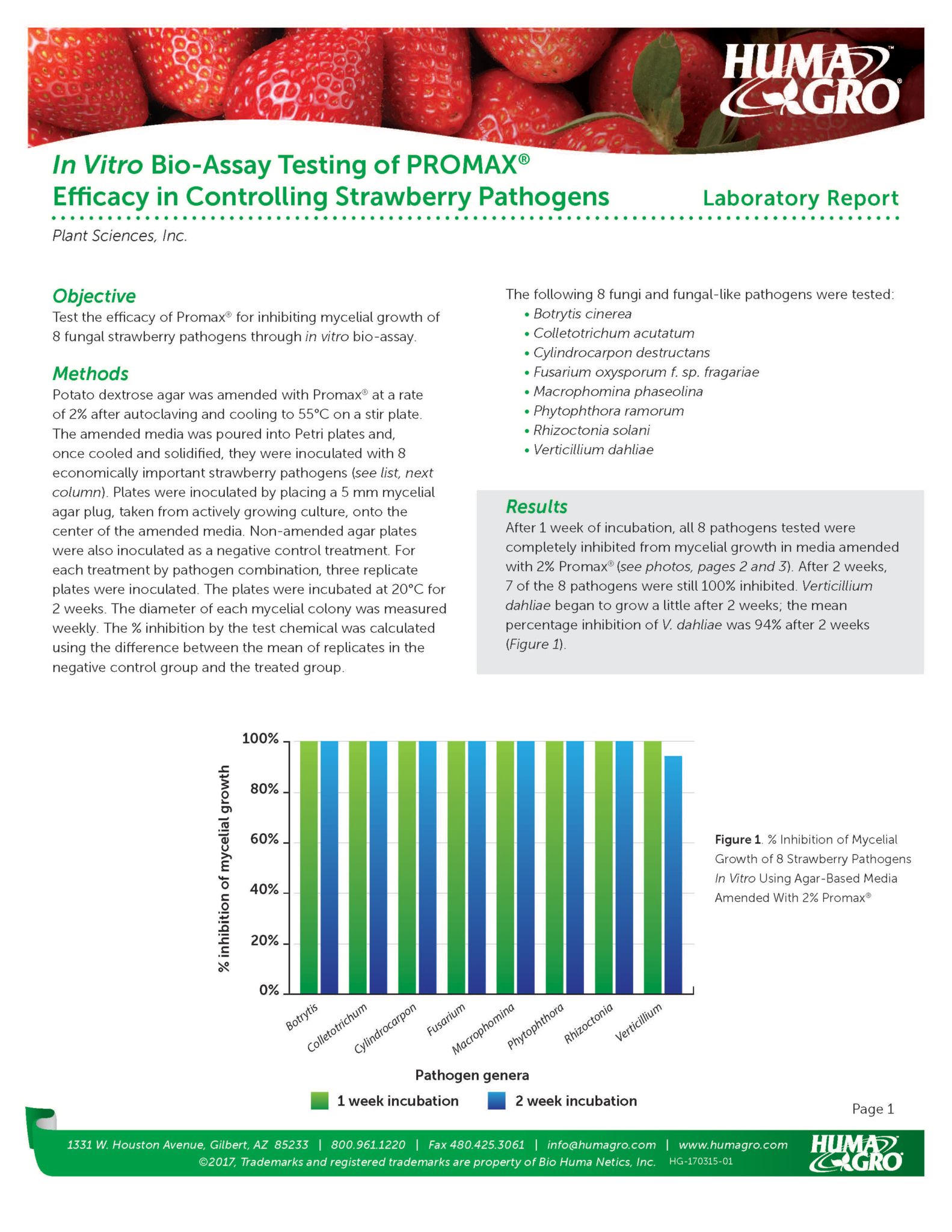
 Plant Sciences, Inc., conducted an independent study to test the efficacy of Promax® for inhibiting mycelial growth of 8 fungal strawberry pathogens through in vitro bio-assay. The following 8 fungi and fungal-like pathogens were tested:
Botrytis cinera
Colletotrichum acutatum
Cylindrocarpon destructans
Fusarium oxysporum f. sp. fragariae
Macrophomina phaseolina
Phytophthora ramorum
Rhizoctonia solani
Verticillium dahlia
After 1 week of incubation, all 8 pathogens tested were completely inhibited from mycelial growth in media amended with 2% Promax® (see photos, pages 2 and 3). After 2 weeks, 7 of the 8 pathogens were still 100% inhibited. Verticillium dahlia began to grow a little after 2 weeks; the mean percentage inhibition of V. dahliae was 94% after 2 weeks (Figure 1).
Read the full report:
View Online Download PDF

Related Posts

Huma Gro® 2017 Product Catalog Released
Bio Huma Netics, Inc. (BHN)—an Arizona company that produces products under the Huma Gro®, Huma Gro® Turf, and Probiotic Solutions® brands—has released its 2017 Huma Gro® Product Catalog. The newly redesigned catalog contains specific information on 45 Huma Gro® liquid crop nutrition and protection products in the categories of Primary Macronutrients (9), Secondary Macronutrients and

Promax® Efficacy in Controlling Strawberry Pathogens
Plant Sciences, Inc., conducted an independent study to test the efficacy of Promax® for inhibiting mycelial growth of 8 fungal strawberry pathogens through in vitro bio-assay. The following 8 fungi and fungal-like pathogens were tested: Botrytis cinera Colletotrichum acutatum Cylindrocarpon destructans Fusarium oxysporum f. sp. fragariae Macrophomina phaseolina Phytophthora ramorum Rhizoctonia solani Verticillium dahlia After

SUPER PHOS® and SUPER NITRO® Improve Spring Wheat Grain Yield and Quality
Research by Olga Walsh, PhD, University of Idaho The objectives of this study were (1) to compare the Micro Carbon Technology®-based phosphorus (P) product Super Phos® (SP) with traditional phosphorus (P) fertilizers ammonium polyphosphate (APP), and diammonium phosphate (DAP); and (2) to compare the Micro Carbon Technology®-based nitrogen (N) product Super Nitro® (SN) with the traditional nitrogen fertilizer, UAN. Huma Gro®