
In this first trial application of Fertilgold® Organics products on organic white corn, the grower was asked to evaluate the ease of use and the effectiveness of 4 new OMRI-Listed liquid Fertilgold® Organics crop nutrition products based on known field deficiencies.
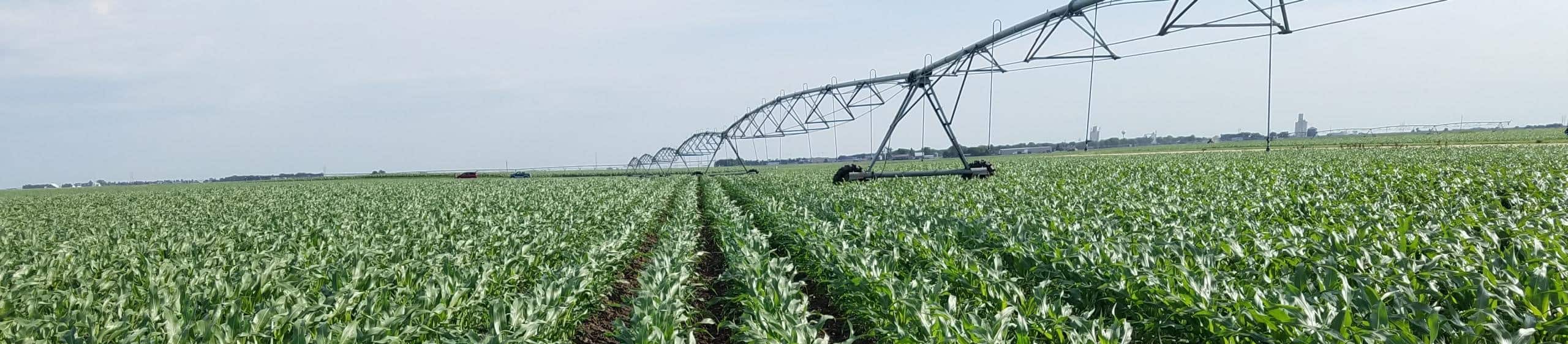
Two 80-acre plots of organic white corn in eastern Nebraska were at the tassel growth stage. The Control plot was to continue to use an OMRI-Listed grower’s standard fertilizer program, while the second plot, the Trial plot, would replace the grower’s standard fertilizer program with new OMRI-Listed Fertilgold® Organics products from post-tassel stage through harvest.
METHODOLOGY
The grower was supplied with 4 OMRI-Listed Fertilgold® Organics products pre-blended for application at the post-tassel growth stage on the Trial plot. These included K-6 (potassium 6%), Mg (magnesium 5%), Ca (calcium 8%), and Micros 1 (containing sulfur 5% and the following micronutrients: boron 0.40%, copper 0.16%, iron 4%, manganese 2%, molybdenum 0.128 %, and zinc 1%).
In addition, Huma Gro® Proud 3®, an organic, OMRI-Listed liquid foliar insecticide-miticide-fungicide was mixed and applied with the other products. A second application of K-6 was applied at grain fill. (See Table 1 for rates.)
All products tested and control products used were OMRI-Listed and approved for use in advance by the grower’s certification agency. Both corn plots had the organic fertilizer applied through foliar broadcast using a center-pivot irrigation system.
RESULTS
Plant tissue analysis indicated that, in all instances, nutrients from the OMRI-Listed Fertilgold® products were entering the plant as effectively as the grower’s standard fertilizer program. Yield results for the Trial plot averaged 2–3 bushels per acre higher than the Control plot.
The grower reported product ease of use as being a major benefit, as the Fertilgold® liquid products had low viscosity and did not clog the fertigation equipment for the pivot. Also, since the products could be applied with irrigation, no additional physical passes over the field were required for fertilizer application. The grower also commented that she really appreciated that all the specific nutrients the crop needed were available and could be delivered within 10 days of deficiency identified by tissue analysis, when they could do the most good, and she was impressed with Fertilgold®’s customer service both in building a customized solution to reduce deficiencies in her organic white corn field and the partnership throughout the process.
CONCLUSIONS
The trial demonstrated Fertilgold® Organics liquid products to be effective, easily applied, and flexible in terms of nutrient choices for organic white corn grown on a center pivot irrigation system.
Click here to download a PDF version of the full report. Click here to read the full report online.
Haga clic aquí para descargar una versión en PDF del informe completo.

Related Posts

Flooded Fields, Missed Chances: The Cost of Untimely Rain
Too much rain at the wrong time can ruin a season. In May, Delta farmers were hit with nearly double the average rainfall, flooding fields and delaying crucial work. From missed nitrogen applications to replanting setbacks, timing is everything—and this spring, Mother Nature threw a major curveball.

This Week in Ag #29
We all do it. We track time by referencing memorable items that we or our family once possessed. “Back when he drove that blue Silverado”, or “when she had that yellow Labrador” are examples of how we recall events that shaped our lives. For farmers, those points in time are often defined by a tractor.

Proven: Nutrient Uptake In Just One Hour
Case Study: Proven - Nutrient Uptake In Just One Hour In foliar applications, speed matters. In just one hour, SUPER POTASSIUM showed a 22% increase in leaf potassium levels, proving its rapid uptake, even under tight spray windows and unpredictable weather.