
Conducted by: Southeast Ag Research, Inc.
Huma Gro Products Used: Breakout®, Max Pak®, Vitol®, and Zap®
Objective
The purpose of this research project was to evaluate how Huma Gro® liquid fertilizer products with Micro Carbon Technology® affect cucumber yield when compared with a control program of grower’s standard fertilizer.
Materials and Methods
This study was conducted at the Southeast Ag Research facilities in Chula, Ga. The experiment was conducted with four replicates. Each replication consisted of a 30-foot-long plot.
The Check plot used only an application of the grower’s standard fertilizer program. The Huma Gro® plots also used the grower’s standard fertilizer program; in addition, the 4 Huma Gro® liquid products were applied. The Huma Gro® products included Zap® (soil health and fertility enhancer, applied as a soil drench at transplant), Breakout® and Vitol® (plant growth optimizers, foliarly applied 3 times during the season), and Max Pak® (micronutrients, foliarly applied with the plant growth optimizers 3 times during the growing season).
Results
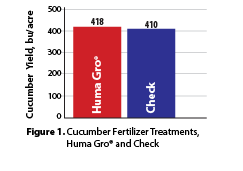
The Huma Gro® fertilizer treatment increased cucumber yield by 8 bushels per acre when compared with the Check treatment (Figure 1). The Check yielded 410 bu/acre, while the Huma Gro® treatment yielded 418 bu/acre.
Conclusions
The Huma Gro® fertilizer treatment increased the yield by 2% (8 bushels per acre) over the Check, with a return on investment (ROI) of 113%. The Huma Gro® program can help cucumber farmers be more profitable while increasing yield.
- To view the complete report, click here.
- To view a Cucumber Crop Product Summary, click here.
- To view a complete Huma Gro program for Cucumbers, go towww.humagro.com/cucumbers.

Related Posts

When Winter Hits the Herd
Arctic cold swept much of the country this winter, prompting warnings to bring pets indoors. But cattle don’t get snow days. Built with an internal furnace and guided by generations of husbandry wisdom, ranchers and their herds weather the cold together—fed, watered, dry, and checked no matter the conditions.

The Tradition of Easter Eggs: From Symbolism to Celebration
The Tradition of Easter Eggs: From Symbolism to Celebration Easter is not only a time for religious reflection, but also a celebration of the season's most iconic symbol: the egg. Did you know Americans purchase 180 million eggs just for Easter? Eggs have long been associated with new life, which makes them the perfect symbol for this holiday. The practice of gifting eggs dates back to early Christianity, when eggs were saved during Lent—a time when fasting meant meat could not be consumed. But eggs, easily preserved without refrigeration, were kept and often given to children on Easter, sometimes painted red to symbolize the blood of Christ. Today, we still celebrate with hard-boiled and decorated eggs, but modern Easter traditions also include the ever-popular chocolate eggs. In fact, over 91 billion chocolate eggs are sold for Easter each year! Another beloved tradition is the Easter Egg Roll, a fun and historic event symbolizing the rolling away of the stone from Christ’s tomb. The White House has hosted an official Egg Roll since 1878, and today, it continues to bring joy to thousands, thanks to the efforts of our First Ladies.

Ducks Walking on Water?
by Heather Jennings, PE Bio Energizer® Reduces Sludge Over 40% at Utah Municipal WTP The case study described below was a project that I worked on with a small-lagoon municipal system so overwhelmed with solids that state action was being taken. The ducks on the other side of the lagoon from me literally looked as