
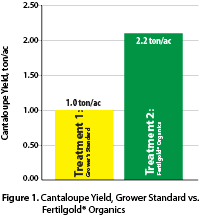
 In this study of Fertilgold® Organics macronutrient (Fertilgold® 3-2-4) and micronutrient (Fertilgold® Micros I) liquid products compared with a grower’s standard treatment on organic cantaloupes applied under field conditions in Arizona, the Fertilgold® Organics treatment powered by a proprietary Micro Carbon Technology® resulted in a 120% yield increase with a 3-to-1 return on investment (ROI).
The research, conducted by Helena Agri-Enterprises at The University of Arizona Yuma Agricultural Center, was conducted as a randomized complete block design with five replications. Each replication consisted of 30 feet long by 80 inches wide beds. Treatments were applied to cantaloupe (Cucumis melo cantaloupensis) cultivar ‘Caribbean gold.’
Download/read the complete report here.

Related Posts

This Week in Ag #69
As we celebrate National Dairy Month, my thoughts are with Jack & Frances Watt, my old neighbors (when you live in the country, a “neighbor” can reside within at least 5 miles of you) who were dairy farmers. They were among the hardest working, kindest people I’ve ever known. Vacations were a foreign concept to

Seedling to Season’s Greetings
From fresh pine scent to sustainable farming, real Christmas trees do more than brighten the holidays. This week, we explore how America’s Christmas tree farmers grow a renewable crop that supports local agriculture, boosts wildlife habitat, and helps the environment, one seedling at a time.

Does Eutrophication cause Algae Blooms?
Eutrophication is the structural change of water ecosystems that is caused by excess nutrients. Eutrophication results in algal blooms and poor water quality. By Jael Batty In this article, we discuss what causes eutrophication, how it affects the environment, and how it is treated.