
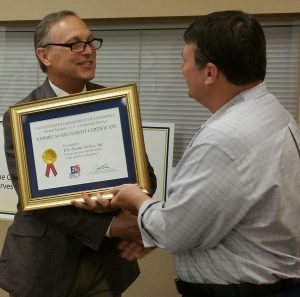
 The United States Department of Commerce (USDC) has awarded Bio Huma Netics, Inc. (BHN) an Export Achievement Certificate in recognition of recent accomplishments in the global marketplace. The certificate was presented to BHN CEO Lyndon Smith in Phoenix by Congressman Andy Biggs (Arizona’s Fifth Congressional District).
In presentation remarks, it was stated that, “For the past 8 years, Bio Huma Netics has worked closely with the International Trade Administration, especially here in Phoenix, to identify capable global partners and understand foreign countries’ regulations. Presently, Bio Huma Netics exports its products to over 30 different countries in Latin America, Asia, Australia, and Europe. Their global success is proof positive that an Arizona-based manufacturing company can successfully overcome market entry obstacles and achieve noteworthy success in almost any international market.”
BHN CEO Lyndon Smith stated that Bio Huma Netics is very proud of its international sales success and appreciative of this recognition from the United States Department of Commerce. He attributed BHN’s global success to its Huma Gro® line of liquid fertilizers that increase the quality and yield of previously low-producing crops, providing sustainable-agriculture food products while commensurately preserving the environment and the earth’s natural resources.

Related Posts

BIO ENERGIZER® Reduces Sludge 45% In One Year, Saves Municipal Plant $6 Million In Dredging Costs
by Heather Jennings, PS In this study, a one-year bioremediation plan featuring Bio Energizer® was implemented for a municipal wastewater treatment facility with 2 primary lagoons in which sludge depths had reached 5–7 feet. The lagoons were at risk of upset and wastewater processing capacity was reduced. Bio Energizer® was added via peristaltic pump to

This Week in Ag #66
When asked if he was finished with planting, dad would frequently respond by saying, “the first time.” His cynicism aside, replant decisions can be difficult. This year, too many growers are faced with that decision. If you plant when the soil is cold and wet, you’re inviting problems. But even if you plant in good soil conditions,

NMRWA 2019 Instructor of the Year Award Presented to Probiotic Solutions® Project Engineer, Heather Jennings
By Jael Batty Bio Huma Netics, Inc. congratulates Heather Jennings, Project Engineer for Probiotic Solutions®, who was awarded Instructor of the Year at the New Mexico Rural Water Association (NMRWA) Conference on April 10. Ms. Jennings, who has been training and presenting for five and a half years, teaches basic and advanced wastewater math for