
This Week In Ag #160
No profession embraces its nostalgic past like farming. Antique tractors. Old red barns. Burlap sacks. These are prized relics of farming’s past, still cherished today. But few relics symbolize the bridge between farming’s past and present quite like the pocket notebook.
Long before the use of satellite imagery, electronic sensors, mapping software and apps, there was the pocket notebook. It was as essential to planting season as the seed itself. Whether staple-bound on the side or spiral-bound at the top, the only prerequisite was that they fit easily in your shirt pocket. Every seed company gave them out as plentifully as they do hats.
Inside, they contained brief information about various seed products, a calendar, conversion charts, settings recommendations for planters and other useful formulas and info.
But make no mistake: their primary use was that of a field diary. That’s why each pocket guide featured plenty of blank pages.
Farmers used them to record and track the products they planted and used in each field. Often, multiple hybrids/varieties are planted in a field. They could be recorded, such as “3417 on north 40, 3394 on the next 40, 6560 in the south 40.” You might even find crude renderings of a field map, complete with waterways, with lines drawn (that’s what mine looked like). You’d also record dates, planting rates and soil conditions. Along with seed, you’d document what/when crop protection and fertilizer products were applied.
You’d carry the pocket guide when you scouted crops, taking notes throughout the season. You noted pest and weed pressure and observations about crop conditions. And you always recorded rainfall. During harvest, you’d make crop observations (remember, this was well before yield monitors) about the condition of the crop, escaped weeds and record yields.
You could tell a lot about a farmer from his pocket notebook. It essentially was his personal diary, his thought process and a window into his personality. That was certainly the case for my Dad.
Over the weekend, I came across one of Dad’s old pocket notebooks. It was from the early 1990s. On one spread, I noticed what looked like late-season corn evaluations. He must have done some hand checks to estimate yields. It appears he was in the process of ordering seed for the next season (in the Midwest, in order to get the best discounts, you often need to order next year’s seed before this year’s is harvested).
Dad’s evaluations of the corn hybrids were far from scientific. But it captures a perfect glimpse into his mindset. It was also the last year he ever planted Northup King!
While I chuckled fondly while going through Dad’s pocket notebook, it made me wonder how my sons will react if they ever come across one of mine.

Related Posts
This Week in Ag #43
December 8th is #NationalChristmasTreeDay. This of course sets up the great debate, real or fake? While every family weighs the pros and cons of choosing the Tannenbaum they rock around, a popular nation is that fake trees are more eco-friendly. After all, they can keep for many years, right? And isn’t it bad to cut down real trees merely for decoration? Not so fast.
Making Memories by Making Hay
Making Memories by Making Hay A nostalgic look back at the labor, sweat, and family memories made during hay season — from hand-stacking square bales to the arrival of the game-changing round baler.

The Immortal Words of a Corn Legend
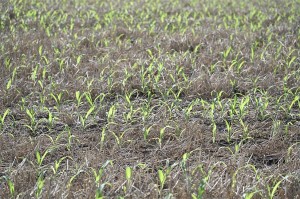
"Any corn plant that doesn’t emerge within 12 hours of others is a weed.” Immortal words from an immortal farmer. My friend Steve Albracht. The brash Texan certainly had a way with words. And with corn. I called him the Ric Flair of corn growers – he held as many National Corn Growers Association (NCGA) yield contest titles as Flair has wrestling championships. And he was just as bold. Visiting his Hart, Texas, farm was akin to visiting that of Francis Childs or Roswell Garst. Fast, uniform crop emergence and singulation weren’t just a goal; it was his obsession. He wanted every plant in the entire field to emerge within eight hours. Studies show that plants emerging 24 hours later can lose up to 25% of their yield. While some corn hybrids may be called racehorses, they don’t close on each other like racehorses do. Slow emergers and runt plants will never catch up to early risers.