
When it comes to foliar sprays, timing is everything. Growers often face tight application windows and unpredictable weather. The ability for a nutrient to move quickly into the plant doesn’t just improve efficiency; it helps ensure your application delivers results, even when conditions aren’t perfect.
The Objective:
We designed a simple but powerful trial: Could a foliar application of SUPER POTASSIUM® move into plant tissue within just one hour?
The Trial:
The trial was conducted on sweet corn in Casa Grande, Arizona. A small plot was split into treated and untreated sections, with the treated side receiving a foliar spray of SUPER POTASSIUM at a rate equivalent to two quarts per acre.
One hour after application, leaves were collected, thoroughly washed to remove any surface residue, dried, and analyzed for potassium content in the Huma laboratory.
The Results:
In just one hour, the treated plants showed a 22% increase in potassium levels within the leaf tissue compared to the pre-treatment. No phytotoxicity was observed.
Why This Matters:
Rapid absorption turns every spray into a smart investment. When nutrients enter the plant quickly, you get more than just an efficient uptake; you gain rain-fast protection. This study demonstrates that SUPER POTASSIUM, powered by Micro Carbon Technology, is rapidly absorbed into plant tissue, helping safeguard your investment even when the weather is unpredictable. With Huma, you’re not just spraying, you’re delivering nutrients with confidence.
See the full trial details and data in our complete case study here.

Related Posts

BHN Welcomes Rich Lamar to the Humic Research Team
On May 1, 2019, Dr. Richard Lamar joined Bio Huma Netics, Inc. (BHN) as Senior Director of Humic Research. He brings a tremendous amount of skills, experience, and knowledge of humic substances to BHN. Dr. Lamar has a B.S. in Biology from the University of Miami, a M.S. in Forestry from Mississippi State University, and

The South Is Sweating and So Is The Corn
Just step outside. It's brutal. You’ll instantly know it’s “sweating season” across the South and much of the Midwest. Sure, temperatures are hot, consistently now in the upper 90s across the Delta. But it’s the humidity that instantly gets your attention and triggers sweat glands overload. The dew point - aka "the misery index" - indicates the temperature where dew forms: the higher the dew point, the more moisture is in the air. The National Weather Service defines dew points above 75 degrees as “oppressive.” That’s where we’ve consistently been across the Delta; most days reaching the upper 70s.
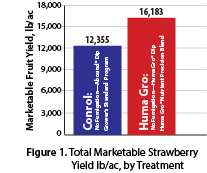
Univ. of Calif.: Huma Gro® Increases Strawberry Yields 30%
Huma Gro® Ultra-Precision™ Blend Plus Root Dip Increases Strawberry Yields 30%, Univ. of Calif. Conducted by: Surendra K. Dara, PhD, University of California Huma Gro® Products: Ultra-Precision™ Blend; plus root dip of Breakout®, Promax®, Vitol®, and Zap® OBJECTIVE The purpose of this research project was to evaluate how a special blend of fertilizer solution and