
Background:
Farmers who try to supply K2O needs on the farm don’t have too many options to get K into the plant, especially in deficient soils. A typical application is KCl which contains an excess amount of Chloride which may not be beneficial to the plant and soil microbes. Huma’s Micro Carbon Technology® based Super Potassium® was tested to see if farmers can replace their K2O deficiencies with Super Potassium.
Objective: The aim of this field study was to assess the effect of replacing dry KCl fertilizer with Super Potassium and measure tissue analysis and yield to see if Super Potassium can supply the K needs for the crop during the growing season.
Materials and Methods:
2nd year cotton (cotton planted behind cotton the year prior) was planted on an irrigated field near Marianna, Arkansas. The first year of cotton had K deficiencies and yielded 1100lbs/ac with known K deficiency. In the 2nd year, the 250lbs/ac recommendation of KCl was replaced with 3 gal/ac of Super Potassium (14.6lbs of actual K2O vs 150lbs actual K2O). The Super Potassium was broadcast sprayed over the entire field. The farmer stated that “If Super Potassium® was going to show, it would be here”. The field next to the test field had an application of 250lbs/ac KCl. Tissue analyses were taken at 3 separate times: pin-head square, mid-bloom, and late-bloom, and the K2O levels in the plant were compared. All K2O levels were above 1.5% besides the pin-head square sample for the KCl applied field.
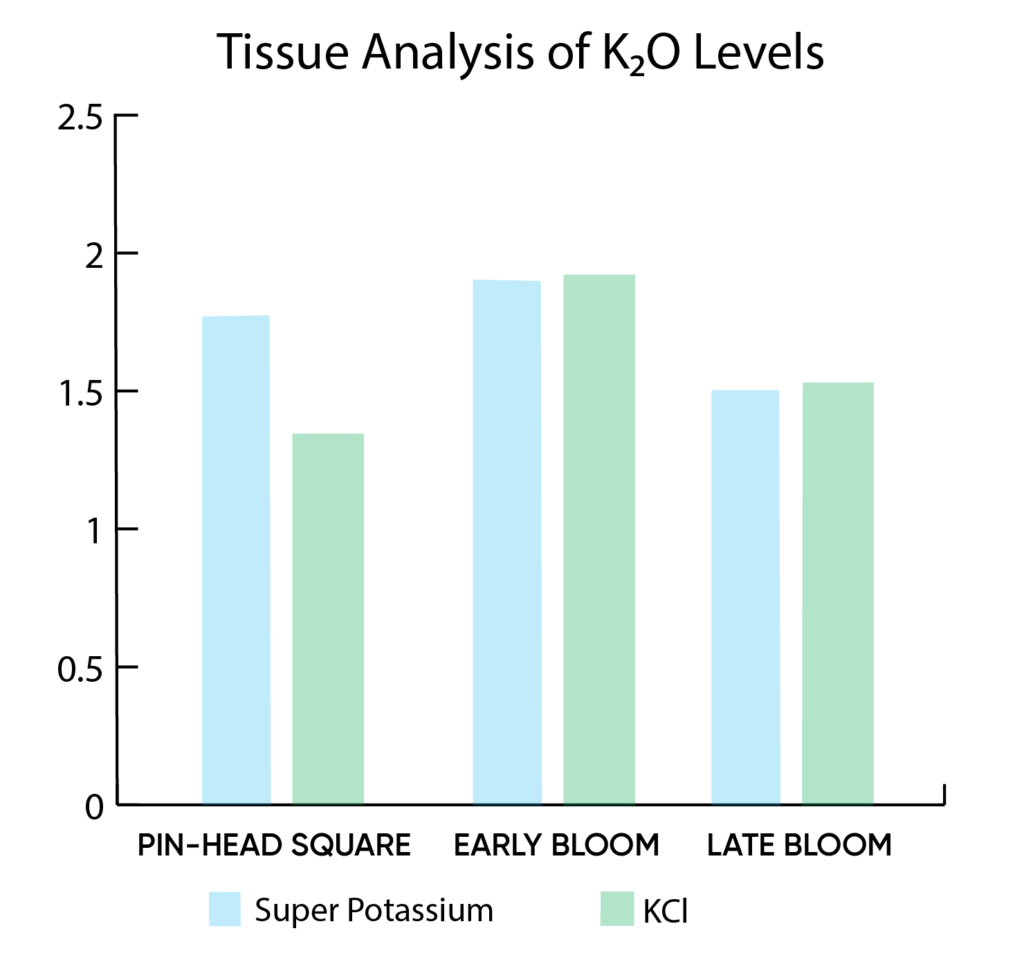
Super Potassium Cotton Chart
“Most impressive thing. I’m telling you. We had one of our lowest potassium fields… 1100 pounds the year prior which showed K deficiency. Next year we did cotton, but we did do a couple fields with 3 gallons of Super Potassium. Cotton after cotton – we made 1500lbs with 0 K deficiency.”
Jason Felton
Super Potassium showed that it is a competitor for K levels in the plant vs dry K fertilizer even applying 10 times less K2O. Further testing should include strip or side by side trials in the same field with ROI and yield measurements, as well as analyses to determine cost savings of storage, freight, and application of Super Potassium vs KCl.