
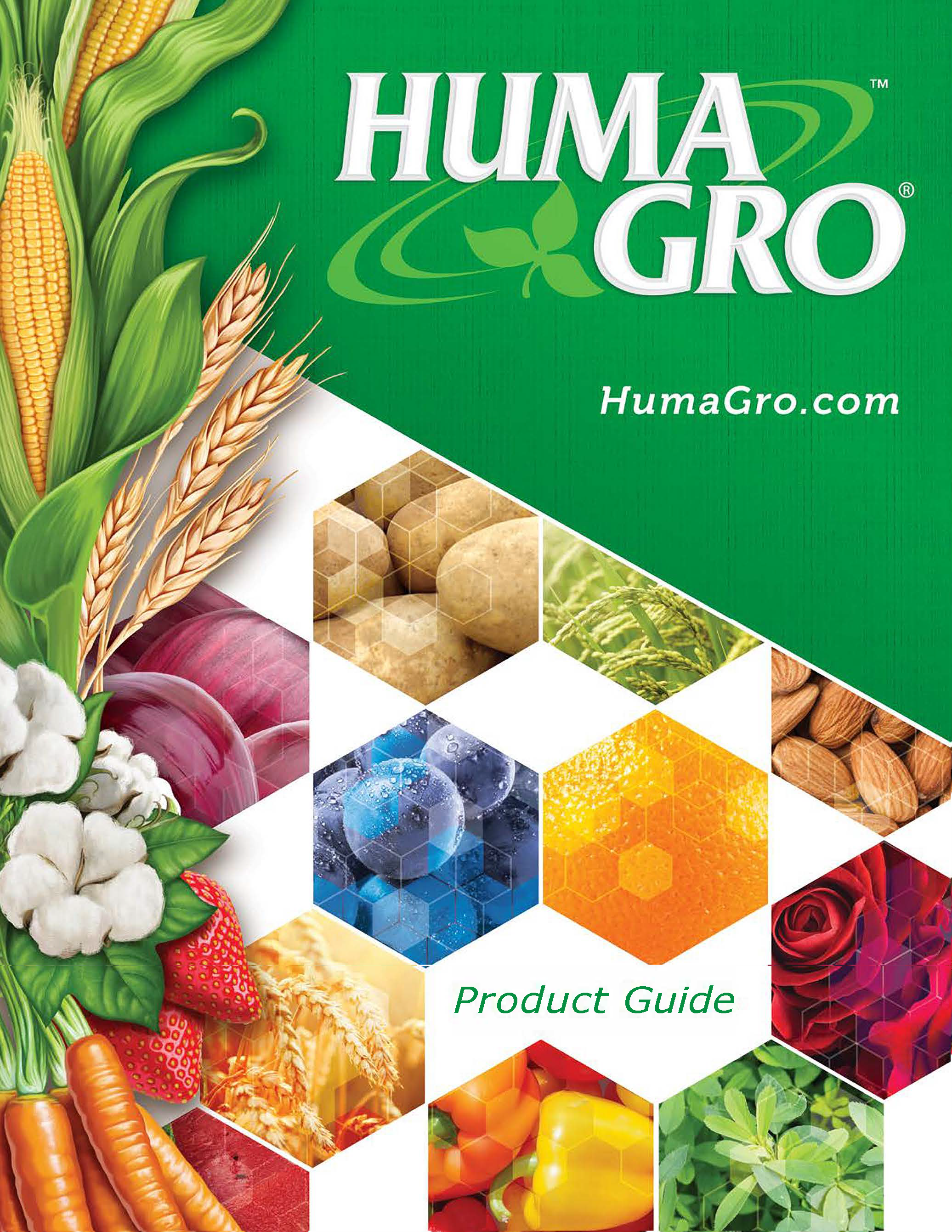
 Bio Huma Netics, Inc. (BHN)—an Arizona company that produces products under the Huma Gro®, Huma Gro® Turf, and Probiotic Solutions® brands—has released its 2017 Huma Gro® Product Catalog.
The newly redesigned catalog contains specific information on 45 Huma Gro® liquid crop nutrition and protection products in the categories of Primary Macronutrients (9), Secondary Macronutrients and Micronutrients (14), Optimal Growth Management (8), Sustainable Soil Fertility (5), Carbon-Rich Organic Acids (5), Zero-Residue Crop Protection (2), and Specialty Products (2).
In addition, the new catalog provides updated application rates for all products, all new crop programs for 8 key crops, product testimonials from growers who have used the products, and field trial results and photos.
Huma Gro® products are formulated with a proprietary Micro Carbon Technology® that provides an ultra-efficient delivery system for precision nutrition at each growth stage to yield premium crops. In addition, Huma Gro® products have a positive environmental impact by promoting overall soil and plant health through efficient foliar nutrition and the growth of roots and beneficial microorganisms in the soil.
The 2017 Huma Gro® Catalog is available to view online or as a downloadable PDF (for Spanish, view online or download pdf). Print copies of the catalog are available from distributors upon request. More information about Huma Gro®, Huma Gro® products, and the value of becoming a Huma Gro® product distributor is available at www.humagro.com. The Huma Gro® App for Android smart phones is available at Google Play.

Related Posts

Bio Huma Netics, Inc., and Mesa Verde Resources Form Strategic Alliance
Bio Huma Netics, Inc. (BHN)—an Arizona company that produces products under the Huma Gro®, Huma Gro® Turf, and Probiotic Solutions® brands—has recently formed an alliance with Reid Enterprises LLC, which does business as Mesa Verde Resources in New Mexico. Mesa Verde Resources is a humic substance mining company that produces, manufactures, and sells humic-acid and

Promax® Efficacy in Controlling Strawberry Pathogens
Plant Sciences, Inc., conducted an independent study to test the efficacy of Promax® for inhibiting mycelial growth of 8 fungal strawberry pathogens through in vitro bio-assay. The following 8 fungi and fungal-like pathogens were tested: Botrytis cinera Colletotrichum acutatum Cylindrocarpon destructans Fusarium oxysporum f. sp. fragariae Macrophomina phaseolina Phytophthora ramorum Rhizoctonia solani Verticillium dahlia After

BHN 2018 World Conference
The biannual Bio Huma Netics, Inc. (BHN), World Conference was held November 6–9, 2018, at the DoubleTree by Hilton Conference Center in Gilbert, Arizona. The BHN World Conference was attended by 72 Huma Gro®, Huma Gro® Turf, and Probiotic Solutions® product distributors and users representing 18 countries. Conference attendees were welcomed by BHN President and



