
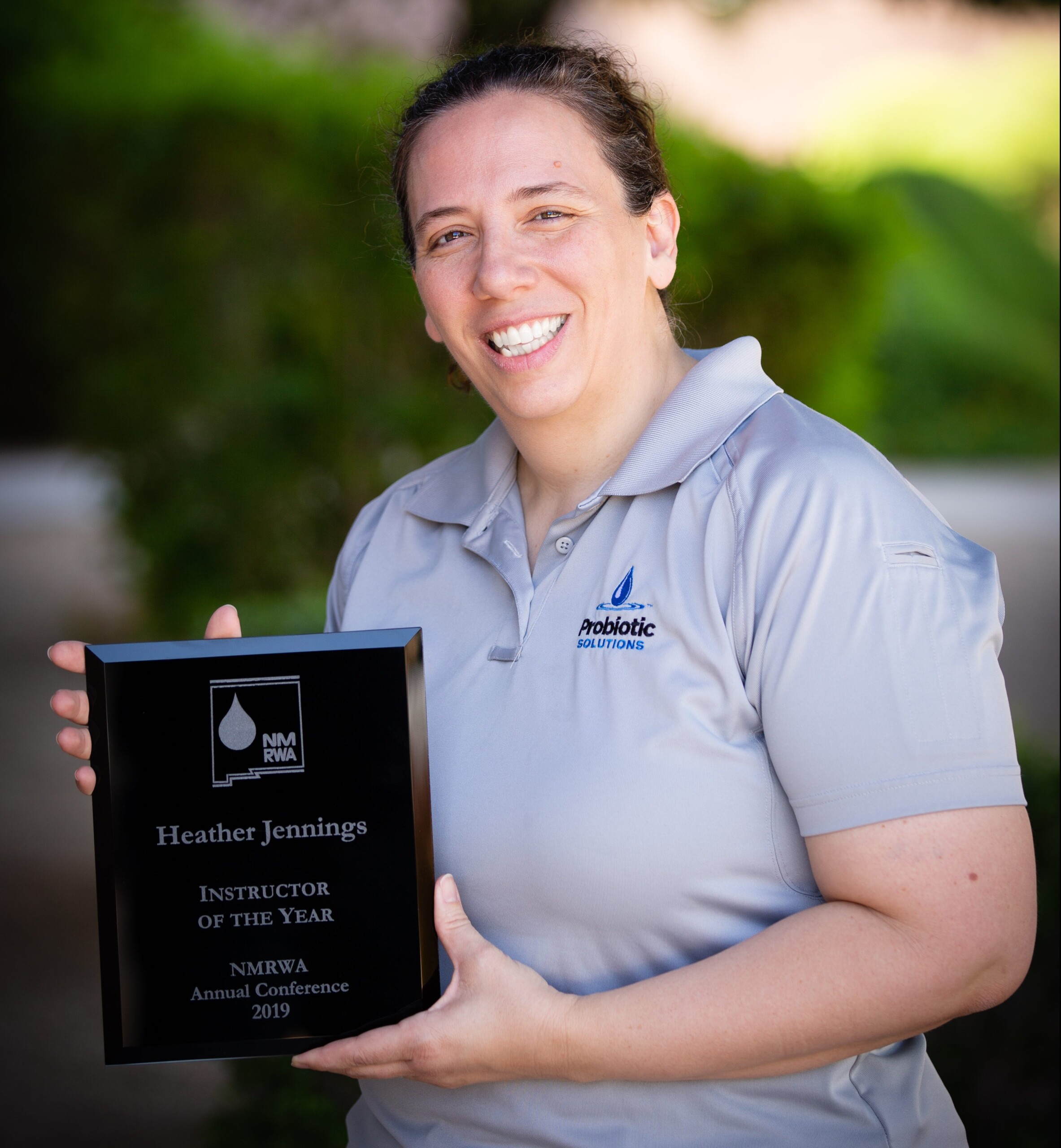
Heather Jennings, Probiotic Solutions® Project Engineer
By Jael Batty
Bio Huma Netics, Inc. congratulates Heather Jennings, Project Engineer for Probiotic Solutions®, who was awarded Instructor of the Year at the New Mexico Rural Water Association (NMRWA) Conference on April 10. Ms. Jennings, who has been training and presenting for five and a half years, teaches basic and advanced wastewater math for certification, a course on microbes, and a nitrification/denitrification course.
NMRWA is a non-profit organization with over 480 water and wastewater system members, representing over 1,297,000 New Mexicans. NMRWA strives to provide the highest quality training and technical assistance and to represent the legislative and regulatory interests of its members.
Ms. Jennings truly enjoys working with NMRWA. “They have a great sense of community. They help each other––there’s no competition. It’s a very good community––a great group of people––that strives to better the water quality in New Mexico.”
Ms. Jennings has been with BHN since 2015. She has a BS in Chemical Engineering from Brigham Young University and has 16 years of engineering experience.
Probiotic Solutions® is the BHN soil and wastewater bioremediation division that assists industries such as food processing, municipal wastewater, pulp and paper, chemical refineries, and others who use water in their processes to treat and return safe, clean water to the environment.

Related Posts

This Week in Ag #45
“Life.” That was my response when asked “What does soil health mean?” during an interview on The Big Show with WHO Radio last week. Whether it’s accelerating populations of soil microbes and worms, creating diverse biological communities or building biomass and aggregates, healthy soils are full of life. The trick is to stimulate and maintain biology in

This Week in Ag #80
Memories awoke recently when I added a Versatile 4WD to my toy tractor collection. It’s a relic of a by-gone era, when thick clouds of smoke bellowed across the Prairies and Plains as steel blades turned the soil. In the 1970s, high horsepower 4WD tractors were all the rage in the Midwest. And our western

Humic Acid Biostimulant Research by BHN Humic R&D Lab Scientists Published in Int’l Agronomic Journal
In its May 2021 issue, Frontiers in Plant Science published a research article by BHN Humic R&D Lab scientists Dr. Hiarhi Monda, Ryan Fountain, and Dr. Richard T. Lamar in collaboration with Dr. Amy McKenna of the National High Magnetic Field Laboratory, Ion Cyclotron Resonance Facility, Tallahassee, Fla. The research, titled “Bioactivity of Humic Acids