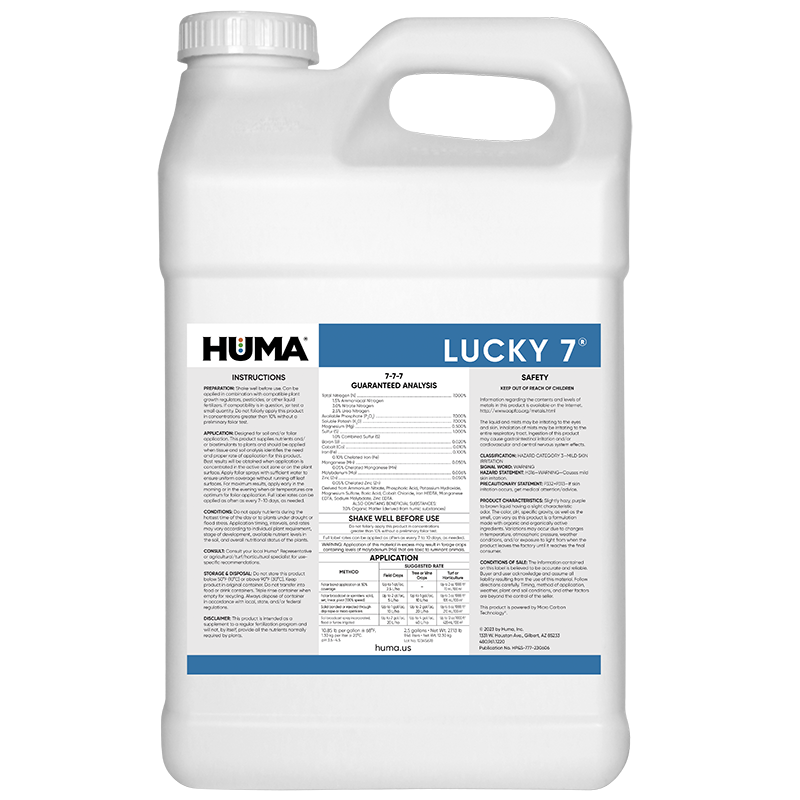
LUCKY 7
Benefits of Use:
- “Leaf friendly” to ensure maximum uptake and translocation
- Stimulates root growth in seedlings and transplants
- Improves overall plant nutrient value and vigor by increasing essential nutrient levels
- Excellent balanced nutrient blend for all crops
- Complete macro- and micronutrients in complexed form for easy, rapid uptake
- Blended for all soil types and regions
- Improves tolerance to environmental stresses
- Excellent product for fertigation
FAQs
Related Videos
Huma Gro Lucky 7: Macronutrient Product
Complete balanced nutrition in one product. A 7-7-7 macronutrient liquid fertilizer with many essential micronutrients. Contains Magnesium, Sulfur, Boron, Cobalt, Iron, Manganese, Molybdenum, and Zinc micronutrients. Developed for all soil types and regions. Stimulates root
Learn More
Related Case Studies

Huma® Program Increases Marketable Strawberry Yields 19%, With an ROI > $5,000/acre
Objective This field trial assessed the effects of an additional 8 foliar applications of Huma® products throughout the growing season on the yield of Monterey strawberries when compared with the grower’s standard crop nutrition program. Materials & Methods This trial was set up in a complete randomized-block design conducted during the growing season of April
Huma® Program Increases Strawberry Yields 14%, With an ROI > $2,500/acre
Objective This field trial assessed the effects of Promax® and Zap® on top of fumigation—plus additional foliar applications of 4 Huma® fertilizer products—on the yield of Portola strawberries when compared with the grower’s standard crop nutrition program. Materials & Methods This trial was set up in a complete randomized-block design conducted during the growing season

Huma® Program Increases Soybean Yields 21%, With an ROI of 389%
Objective This field trial assessed the effects of 2 foliar applications of 2 combinations of Huma® products versus a control during the growing season on the yield of soybeans (Glycine max, variety AG48X7) when compared with the grower’s standard crop nutrition program. Materials & Methods This trial was set up in a complete randomized-block design
Related Blog Posts

Discover Three Products to Prep Your Soil for Spring Planting
As I begin to write, I’m reminded of an excerpt from Ode to the West Wind — “If winter comes, can spring be far behind?” Well, spring is certainly not far behind, especially for those of us working in the agriculture sector. Winter can be a tricky time for growers, as many of them face

This Week in Ag #10
Football may be a game of inches, but farming is a business of fractional inches. Take planting. Seed placement is paramount to the success of a crop. Farmers spend lots of time calculating the optimum rate and depth to plant their seeds based on genetics, soil type, soil conditions, weather, management practices and the desired output

Feeding Freedom: Agriculture’s Role in D-Day
As the world remembers D-Day, it's worth remembering another critical front in World War II: American agriculture. Discover how farmers, innovators, and the Million Acre Harvest Brigade helped feed Allied troops, support the war effort, and contribute to victory.
Related Products
IRO-MAX
IRO-MAX®, carbon-complexed with Micro Carbon Technology®, provides effective and quick iron uptake into the plant. Iron is a key micronutrient...

OM 6 mm(-)
Huma® OM 6 mm(-) is a natural humic and fulvic acid product processed from naturally occurring, oxidized lignite. It provides a...

X-TEND B
X-TEND® B is a concentrated Micro Carbon Technology® product with high levels of organic acids and nutrients. This product is...