
BORON
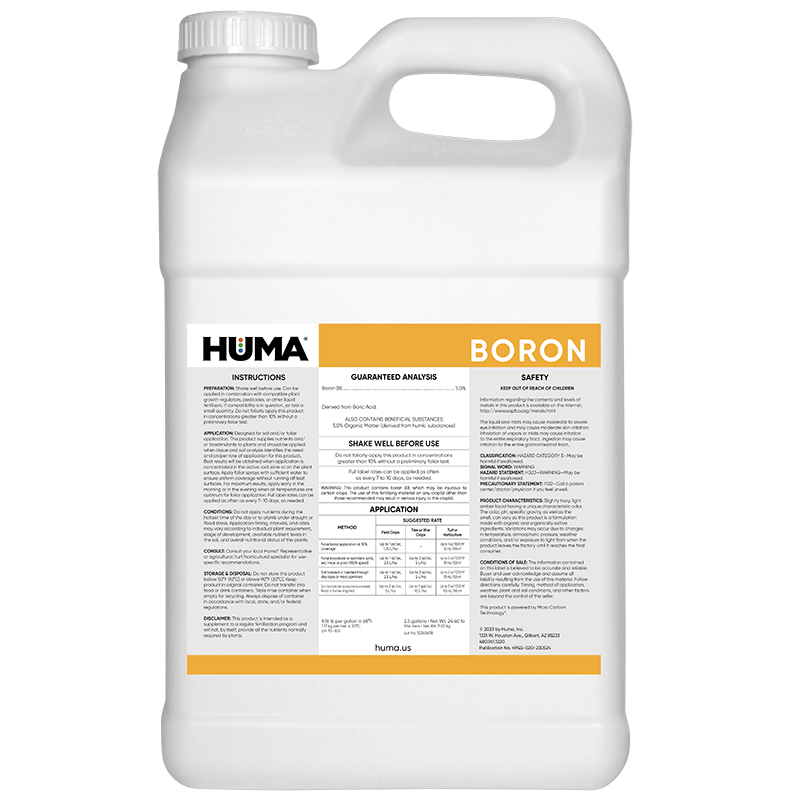
Benefits of Use:
- Supplies boron nutrition necessary for metabolic activity, proper growth, and maturation
- Enhances pollen viability and pollination in flowering crops
- Improves quality of crop
- Is required for cell division and normal tissue differentiation and maturation
- Functions with calcium to form an “intercellular cement” to maintain plant structural integrity
- Improves protein metabolism and reduces nitrate accumulation in young leaves
- Improves sugar transport in plants
Deficiency Symptoms—When to Apply:
- Reduced flowering or improper pollination
- Stubby stem or root growth; weakened cell walls that allow crop lodging
- Thickened, curled, wilted, and chlorotic leaves
- Symptoms of calcium deficiency may appear
- ALFALFA: yellow-reddish leaves in new growth, CORN: pollen tube failure, COTTON: rosette, NUT CROPS: decreased yields in otherwise-healthy trees
FAQs
Related Videos
Huma® Micronutrients and Secondary Macronutrients
Huma liquid micronutrient and secondary macronutrient fertilizers with Micro Carbon Technology (MCT) are extremely efficient. MCT improves nutrient uptake so you can get the most out of your crops. Deliver micronutrients and secondary macronutrients exactly
Learn More
Related Case Studies

Huma® OM Soil Activator Increases Corn Yield 19%, With 240% ROI
Background In an earlier in-house research project, it was observed that OM Soil Activator (formerly known as Fertilgold® Soil) caused plants to grow better and improve soil characteristics. The product was then released for field trial status. Objective The focus of this study was to observe if Huma® OM Soil Activator, an OMRI-Listed product for
Huma® Fertil Soil® Increases Corn Yield With 260% ROI
Background Application of Fertil Soil® to soils in combination with other Huma® fertilizers at various locations previously resulted in crops with improved plant growth and higher yields. Applying Fertil Soil® with grower standard products or as a single product application to soil and leaves could also impact results. Objective The focus of this study was

Effects of Huma® Products on N & P Stabilization in Sandy Soil
Objective To demonstrate the effects of Huma® products X-Tend®, Fertil Humus®, Fertil Soil®, and Zap® on the reduction of nitrogen and phosphorus leaching in Immokalee sandy soils. Background The leaching of nitrogen and phosphate fertilizers presents an ongoing problem in Florida soils. Agricultural amendments that reduce leaching when applied to soils or when mixed with





Related Blog Posts

Save 25% on Phosphorus Fertilizer with Huma SUPER PHOS®
Phosphorus fertilizer prices are at record highs, but Huma Super Phos® offers a smarter solution. With Micro Carbon Technology®, Super Phos® delivers higher nutrient efficiency while saving growers up to 25% per pound of P₂O₅ compared to DAP or MAP.

This Week in Ag #69
As we celebrate National Dairy Month, my thoughts are with Jack & Frances Watt, my old neighbors (when you live in the country, a “neighbor” can reside within at least 5 miles of you) who were dairy farmers. They were among the hardest working, kindest people I’ve ever known. Vacations were a foreign concept to

This Week in Ag #88
No month is more associated with a crop than October is with a certain orange orb. That’s why it’s #NationalPumpkinMonth. Pumpkins are the centerpiece of the booming $1.25 billion US agritourism industry. You-pick pumpkin patches are a main attraction, providing family photo opportunities young mothers love even more than their pumpkin spice lattes. Corn mazes, apple
Related Products
D-FEND
D-FEND®, carbon-complexed with Micro Carbon Technology®, is a foliar formulation of nutrients and refined plant oils that facilitate nutrient uptake...
STABLESOL LIQUID
STABLESOL® LIQUID is an activated liquid humic-acid source derived from a highly oxidized, naturally occurring carbon and mineral deposit. STABLESOL LIQUID treats...
SILI-MAX
SILI-MAX®, carbon-complexed with Micro Carbon Technology®, is a highly available source of silica, which is essential in grains and grasses...