
PROMAX
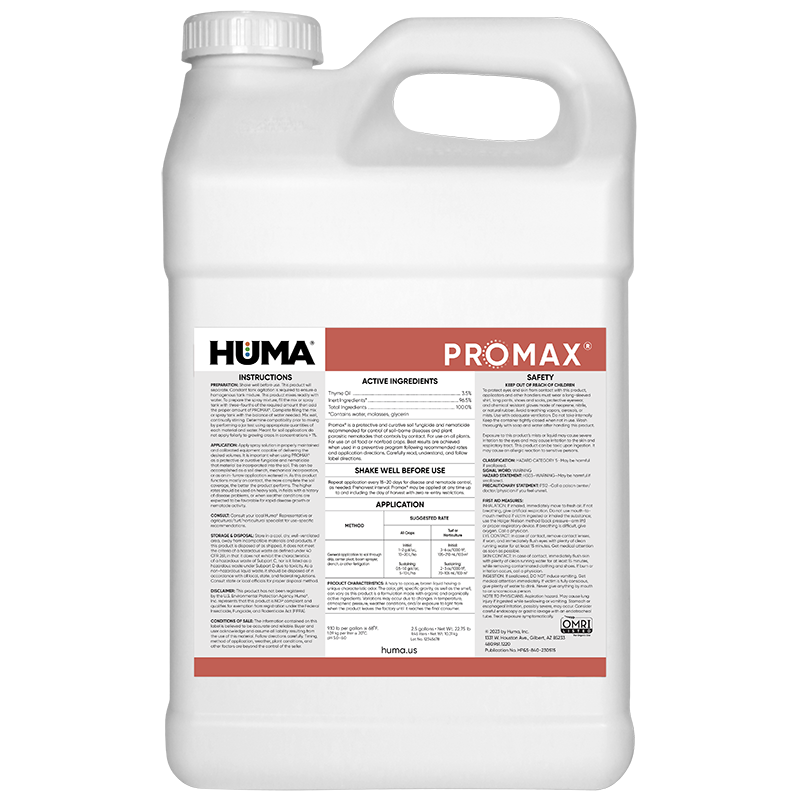
Benefits of Use:
- Inhibits nematode activity
- Provides excellent control of fungal diseases in soils
- Activates natural defense mechanisms in plants
- Safe for crops, humans, and the environment, when used as directed
- Fungicidal effect against all types of fungal spores
- Product’s natural chemistry has no documented cross-resistance
- Cost-effective performance
- Fast-acting upon contact
- Restricted Entry Interval (REI): 0 days
- Pre-Harvest Interval (PHI): 0 days
FAQs
Related Videos
Huma Promax: Crop Protection Product
A soil fungicide and nematicide that eliminates pests and soil-borne disease naturally. OMRI-listed organic pesticide is soil applied to kill soil pathogens and nematodes on contact. Zero residue, no buffer zone, and no re-entry
Learn More
Chili Farmer Performs Field Trials with Organic Pesticide
Chili Farmer Chip Spear of Luna County New Mexico runs field trials using Huma Gro Promax biopesticide. OMRI-listed Promax effectively treats nematodes and soil disease and is safe enough to use throughout the growing season,
Learn More
Farmer Uses Promax and Zap in New Mexico – Testimonial Video
Chili farmer Clint Simmons uses Promax and Zap to treat nematodes on his farm in New Mexico. Promax is an OMRI-listed organic pesticide. Zap stimulates microbial activity after pesticide use.
Learn More
Related Case Studies

Huma® Promax® and Zap® Decrease Charcoal Rot in Florida Strawberry, With Increased Yield and ROI of 10:1
Background Charcoal rot, caused by the soil-borne pathogen Macrophomina phaseolina, can be a significant threat to strawberry production. Two Huma® products, Promax® and Zap®, had previously been shown to be successful in managing soil-borne diseases in strawberries. Objectives The primary objectives of this study were to assess the efficacy of Promax® and Zap® in reducing
Huma® Ultra-Precision™ Blend Plus Root Dip Increases Strawberry Yields 30%
Objective The purpose of this research project was to evaluate how a special blend of fertilizer solution and a root dip made of Huma® products with Micro Carbon Technology® affect strawberry yield when compared with a control program of grower’s standard fertilizer and a competitor root dip product. Materials & Methods Strawberry cultivar San Andreas
Huma® Nutrient and Fumigation Replacement Program Increases Strawberry Yields
Objective This field trial assessed the effects on strawberry yields of replacing field fumigation with periodic applications of Huma® Promax® and Zap® and replacing a grower’s standard fertilizer program with irrigation-applied Ultra-Precision™ blended liquid Huma® crop nutrition products. Materials & Methods This trial was conducted in Arroyo Grande, Calif., using Portola strawberries planted in 40’

Related Blog Posts

This Week in Ag #12
#Plant23 is well underway. From the time seeds are sown, how many days should it take for crops to emerge? That can vary greatly, from days to weeks. But for many crops, it’s not really about calendar days, but Growing Degree Days (GDD).

The Great Beef Brawl: Cowboys vs. Politicians
Tempers flared across the beef belt last week as news broke that the U.S. may import Argentine beef, and ranchers weren’t having it. What followed felt like an old western saloon brawl between cowboys and politicians, complete with economic punches, market swings, and a whole lot of pride on the line.

This Week in Ag #31
#Harvest23 is here! If all goes well, I should be harvesting my corn plot this week. The beginning of fall brings excitement and optimism to the farm. But this year, those feelings appear tempered. Farmer sentiment dropped 8 points last month (according to the Purdue Ag Economy Barometer) as producers shared a dimming view of
Related Products
FERTIL HUMUS
FERTIL HUMUS® carbon-complexed with Micro Carbon Technology® has the nutrients necessary to feed beneficial fungal activity in the soil and...
OM GREENS
Huma's OM GREENS is a natural humic and fulvic acid product processed from naturally occurring, oxidized humic substances. It provides a...
ZAP
ZAP® carbon-complexed with Micro Carbon Technology® is an organic-based formulation of nutrients for feeding the native beneficial soil microbial balance....