
By Lyndon Smith
President and CEO,
Bio Huma Netics, Inc.
 We attended the Humic Products Trade Association (HPTA) annual meeting this past month in Park City, Utah. It’s always a pleasure to get together with industry peers and talk about issues pertaining to HPTA as well as discussing the latest and the greatest research and product developments taking place in the biostimulant movement throughout the world!
Our alliance with HPTA is a long and strong one. From being a participant (with Mesa Verde) since its inception in 2010 and serving as a member of the Board of Directors—it’s been fun to see us come together in unity and how we’ve accomplished many monumental and exciting milestones together.
Before HPTA came into existence, most of us in the humic space had developed our own little “black box”, meaning our own individual way of mining, extracting, and utilizing humic substances. HPTA brought us all under one umbrella and, working together, we have established standard methodologies for testing, qualifying, and quantifying humic substances in its various forms. The numerous regulatory reforms in the industry that have come so far, and that are yet to come, can largely be credited to HPTA’s vision, efforts, and what it stands for.
In recent years, the worldwide biostimulant movement has been a prime focus of the HPTA. The objective of this movement is to carve out a regulatory framework that covers all biostimulants, including humic products. In the United States, this reform would be to identify them as exemptions from the Federal Insecticide, Fungicide, and Rodenticide Act (FIFRA) which is administered and regulated by the U.S. Environmental Protection Agency (EPA). This exemption from EPA’s jurisdiction will enable our industry to help the state regulators understand these products and why they are beneficial to the agriculture industry, and it should help move biostimulants through the registration processes without slowing them down with stricter compliance issues.
It’s interesting that the term “biostimulant” has been in existence for several years now, yet this category has been deprived of a standardized definition and has lacked a clear regulatory path in our country. Under current market conditions facing the world of agriculture today—particularly with the supply chain issues, shortages, and high cost of fertilizers—biostimulants are a clear alternative or additive that can help make fertilizers more efficient and bring down farmer input costs with greater efficacy. Therefore, it’s only fair to recognize the great benefits biostimulants deserve as they become widely accepted in the United States and throughout the world. I must mention that the European Union and multiple other countries such as India, Brazil, etc., have already adopted biostimulant regulatory reforms—this movement is really growing throughout the entire world and we intend to be an integral part of it.
I strongly believe that in addition to simplifying the product registration process, the biostimulant movement can bring greater clarity on what biostimulants are and what they do. Standardization and unification of definitions will not only reduce the confusion and credibility around the use of biostimulants but will also empower the industry to make its dramatic beneficial claims without shame!
Currently, the biostimulant movement is a work-in-progress and has a long way to go, but I’m very optimistic that the combined efforts of the entire biostimulant industry, including the HPTA, has and will create a significant impact. Eventually, the biostimulant movement in the United States will find a national definition and a reformed regulatory framework.

Related Posts

The Water Break Podcast Hits 4,000 Downloads
This week, our Water Break Podcast reached the milestone of 4,000 downloads. Our fanbase is growing quickly, as it took us 18 episodes and 16 months to reach 3,000 downloads but then only 3 more episodes to reach the 4,000-download mark. The statistics report from Blubrry, our podcast hosting service, has also let us know
This Week in Ag #21
You’ve all heard the saying “knee-high by the fourth of July” to describe the progress of a corn crop. It’s a phrase many folks still refer to today. But as the photo below shows, that saying is now laughable. In fact, if you’re a Midwest farmer and your corn is now knee high, it’s probably in big
Univ. of Calif.: Huma Gro® Increases Strawberry Yields 30%
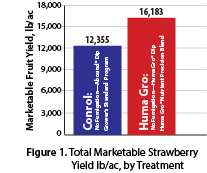
Huma Gro® Ultra-Precision™ Blend Plus Root Dip Increases Strawberry Yields 30%, Univ. of Calif. Conducted by: Surendra K. Dara, PhD, University of California Huma Gro® Products: Ultra-Precision™ Blend; plus root dip of Breakout®, Promax®, Vitol®, and Zap® OBJECTIVE The purpose of this research project was to evaluate how a special blend of fertilizer solution and