
JACKPOT
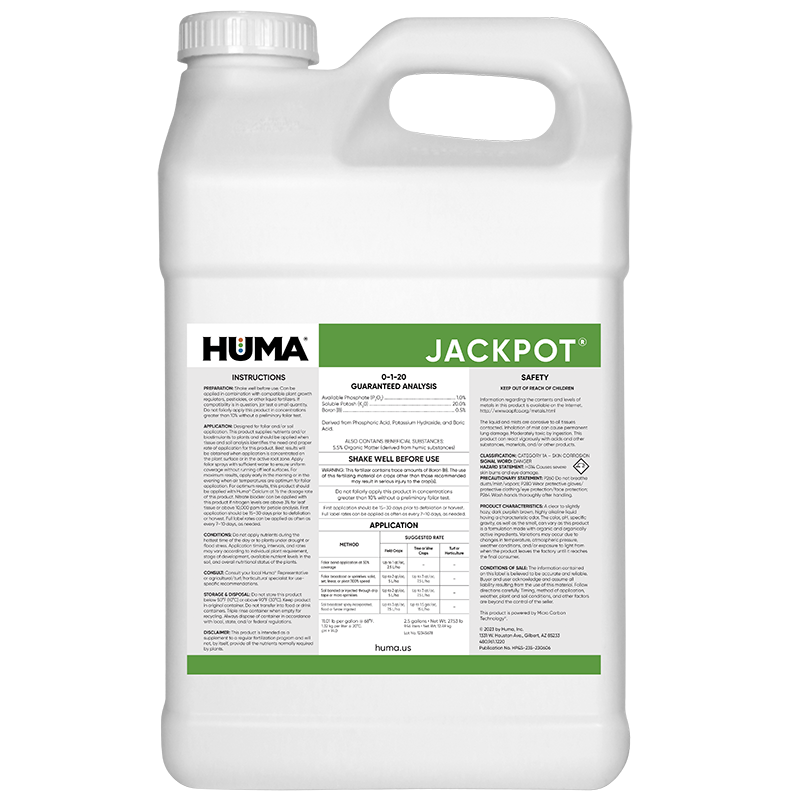
Benefits of Use:
- Promotes sizing and maturity of crops
- Enhances the movement of carbohydrates and proteins from leaves, stems, and roots to the harvested portion of the crop
- Improves quality, shipability, and shelf life of produce
Jackpot® applied with Calcium has the following benefits in crops:
- COTTON: Aids fiber maturity, allowing bolls to open naturally; promotes fiber strength and quality; “finishes” filling out the top crop; and “sets-up” crop for proper defoliation
- POTATOES: Promotes tuber sizing, enhances skin setting and “netting,” improves quality for better shipping and storage, and prepares tubers for harvest without “killing”
- SUGAR BEETS: Enhances sugar content and prepares crop for top removal and harvest
- PEANUTS: Improves quality and grade as well as promotes nut-fill
FAQs
Related Case Studies

Huma® Fertilizer Program Improves Potato Yield by 5%, With 200% ROI
Background Huma® liquid fertilizer programs with Micro Carbon Technology® provide growers with efficient crop nutrients via foliar spray or irrigation at the exact time crops need them. Precision timing of efficient nutrition provides better crop yield and quality. Objective The focus of this study was to assess how the efficient Huma® nutritional products affect potato

Recoverable Sugar of Sugar Beets Yield Increased Using Huma® Program, Year 2
Objective This field trial was conducted to observe effectiveness of additional preharvest applications of Huma® products on recoverable sugar of sugar beets and return on investment. Materials & Methods This trial on sugar beet (Beta vulgais vulg. altissima) was conducted in Homedale, Idaho. The crop was seeded on April 18 and was harvested on October

Huma® Program Increases Sweet Potato Yields 39%, With a 10:1 ROI
Objective This field trial was conducted in order to compare sweet potato crop yields and return on investment (ROI) obtained when a Huma® soil product (Zap®, for feeding soil biology and improving soil fertility) and 2 applications of 3 Huma® foliar nutrients (Jackpot®, Calcium, and Super Potassium®) were applied in various combinations. Materials & Methods

Related Blog Posts

This Week in Ag #45
“Life.” That was my response when asked “What does soil health mean?” during an interview on The Big Show with WHO Radio last week. Whether it’s accelerating populations of soil microbes and worms, creating diverse biological communities or building biomass and aggregates, healthy soils are full of life. The trick is to stimulate and maintain biology in

Save 25% on Phosphorus Fertilizer with Huma SUPER PHOS®
Phosphorus fertilizer prices are at record highs, but Huma Super Phos® offers a smarter solution. With Micro Carbon Technology®, Super Phos® delivers higher nutrient efficiency while saving growers up to 25% per pound of P₂O₅ compared to DAP or MAP.
Beating High Phosphorus Prices
Phosphorus prices for 2026 are painful, but cutting fertilizer rates isn’t the only option. By switching to more efficient sources like SUPER PHOS and unlocking tied-up nutrients with K-HUME, growers can stretch their phosphorus dollars while still pushing for top-end yields.
Related Products
OM PRILLED
OMRI-Listed® OM PRILLED is a natural humic and fulvic acid product processed from naturally occurring, oxidized humic substances. It provides...

OM 2-2-4
Carbon-complexed with Micro Carbon Technology®, OMRI-Listed® OM 2-2-4 is a balanced organic N-P-K product that provides excellent foliar and soil...
TURFPLEX IV
Huma's TURFPLEX® IV is a well-rounded formulation of complexed macro and micronutrients designed to promote lush, green growth in turf...