
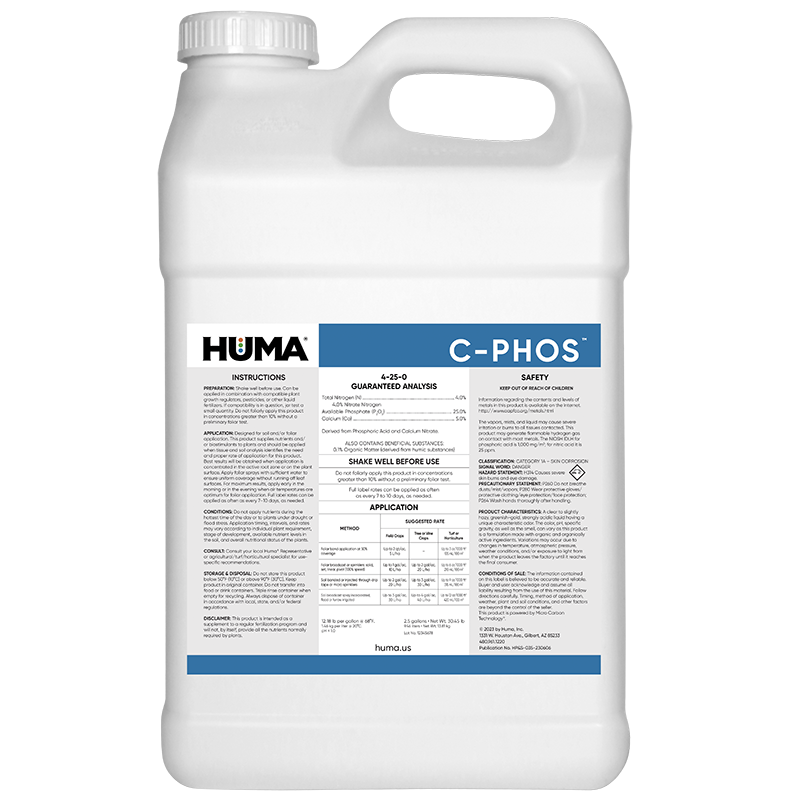
C-PHOS
Benefits of Use:
- Resists “tie-up” with calcium or aluminum to remain water soluble and available to plant roots
- Moves with irrigation water to aid in proper placement
- Can be tank-mixed to improve availability of other nutrient solutions
- Is non-salt-forming
- Aids in phosphorus uptake in cold or waterlogged soils
- Is useful in the cleaning and maintenance of drip irrigation systems
- Aids phosphorus uptake in high pH or calcareous soils
Deficiency Symptoms—When to Apply:
- Slow growth; stunted plants
- Purplish coloration on foliage of some plants (older leaves first)
- Dark green coloration with tips of leaves dying
- Poor grain, fruit, or seed development
- Leaves and terminal buds distorted
- LETTUCE: tip burn; TOMATO/PEPPER: blossom-end rot; CUCUMBER: hollow heart; BROCCOLI: black heart
FAQs
Related Case Studies
Huma® Fertilizer Program Improves Potato Yield by 5%, With 200% ROI
Background Huma® liquid fertilizer programs with Micro Carbon Technology® provide growers with efficient crop nutrients via foliar spray or irrigation at the exact time crops need them. Precision timing of efficient nutrition provides better crop yield and quality. Objective The focus of this study was to assess how the efficient Huma® nutritional products affect potato

Huma® Fertil Soil® Increases Corn Yield With 260% ROI
Background Application of Fertil Soil® to soils in combination with other Huma® fertilizers at various locations previously resulted in crops with improved plant growth and higher yields. Applying Fertil Soil® with grower standard products or as a single product application to soil and leaves could also impact results. Objective The focus of this study was
Huma Liquid Products on Nebraska Corn
Background: Huma's Micro Carbon Technology based products (Fertil Soil®, Super Phos®, and Vitol®) have been shown to improve germination, plant health and vigor, increase phosphorus availability, and improve farming sustainability and regeneratively. Objectives: The aim of this study was to assess the effect of feeding the soil, roots, and the plant itself with Fertil Soil®,




Related Blog Posts

This Week In Ag #92
Should regenerative agriculture resemble a Chinese menu, where you freely pick and choose the ingredients you want to include or eliminate from your entrée, rather than taking a holistic approach? That depends on your perspective of regen farming.

Huma Gro®: Practically Perfect in Every Way for Strawberries
Successful strawberry farming presents many unique challenges. As with every other type of crop, each farm will have its own challenges related to soil, soil tilth, soil pathogens, soil nutrient cycling, nutrient availability, plant vigor, irrigation needs, etc. Combined with those challenges are strawberry farming cultural practices related to continuous cropping and soil fumigation—with the

This Week in Ag #59
“It won’t grow in the bag.” Grandpa never minced words. And that’s how he responded (in frustration) to my dad and uncle whenever they pondered dropping the planter. His philosophy was simple: the moment you can plant, you plant. There’s only so much heat and sunlight Mother Nature offers, so you better take her up on
Related Products
CURIOSITY
Huma's CURIOSITY™ is complexed with Micro Carbon Technology®, provides a unique combination of macronutrients and micronutrients for grass—and biostimulants designed...
JACKPOT
JACKPOT® , carbon-complexed with Micro Carbon Technology® , is a concentrated formulation of potassium and boron that feeds the metabolic processes necessary...
CROP-GARD
CROP-GARD®, carbon-complexed with Micro Carbon Technology®, provides nutrients and refined plant oils for natural plant vigor. CROP-GARD also achieves balanced...