
FERTIL SOIL
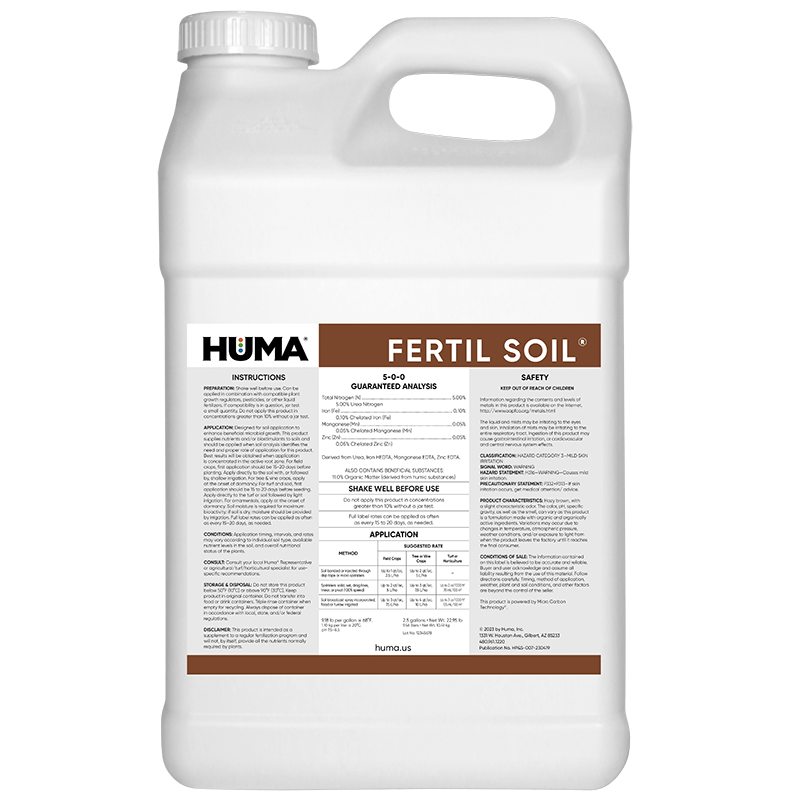
Benefits of Use:
- Boosts beneficial soil microbes
- Improves soil structure and aeration
- Enhances water and nutrient uptake
- Reduces salt and pH stress
- Promotes stronger, healthier roots
Deficiency Symptoms—When to Apply:
- Anaerobic soil conditions
- Low soil organic matter
- Soil compaction or cloddy, crusted soil
- Poor water penetration or retention
- Salt damage or toxicity to plants
- Loss of nutrients by leaching below root zone
- Inhibited root growth, small root mass
FAQs
Related Case Studies

Huma Liquid Products on Nebraska Corn
Background: Huma's Micro Carbon Technology based products (Fertil Soil®, Super Phos®, and Vitol®) have been shown to improve germination, plant health and vigor, increase phosphorus availability, and improve farming sustainability and regeneratively. Objectives: The aim of this study was to assess the effect of feeding the soil, roots, and the plant itself with Fertil Soil®,
Huma® Fertil Soil® Increases Corn Yield With 260% ROI
Background Application of Fertil Soil® to soils in combination with other Huma® fertilizers at various locations previously resulted in crops with improved plant growth and higher yields. Applying Fertil Soil® with grower standard products or as a single product application to soil and leaves could also impact results. Objective The focus of this study was

Effects of Huma® Products on N & P Stabilization in Sandy Soil
Objective To demonstrate the effects of Huma® products X-Tend®, Fertil Humus®, Fertil Soil®, and Zap® on the reduction of nitrogen and phosphorus leaching in Immokalee sandy soils. Background The leaching of nitrogen and phosphate fertilizers presents an ongoing problem in Florida soils. Agricultural amendments that reduce leaching when applied to soils or when mixed with
Related Blog Posts

This Week In Ag #97
New Year’s babies bring a renewed spirit of hope to those whose lives they touch. On January 1, 1865, a baby born in Diamond, Missouri, not only brought hope, but salvation to US agriculture. His name was George Washington Carver.

Evaluation of Micro-Carbon Technology-Based P Fertilizer, SUPER PHOS®, in Spring Wheat

Our Humic Advantage
Humic substances, among the most wondrous products of nature, are the recycled essential residues of life. Plants harvest the sun’s energy and create life from that energy plus the carbon and oxygen they pull out of the air and the minerals they pull out of the soil. When plants die, all of their components are
Related Products
SUPER PHOS
SUPER PHOS®, carbon-complexed with Micro Carbon Technology®, can be foliar-applied, according to label directions, without the risk of phytotoxicity. When...
BORON
Huma's BORON is carbon-complexed with Micro Carbon Technology®, ensures efficient and effective uptake of boron, which is required for cell...
44 MAG
Huma's 44 MAG®, is carbon-complexed with Micro Carbon Technology®, ensures maximum assimilation of magnesium, which is the essential part of...