
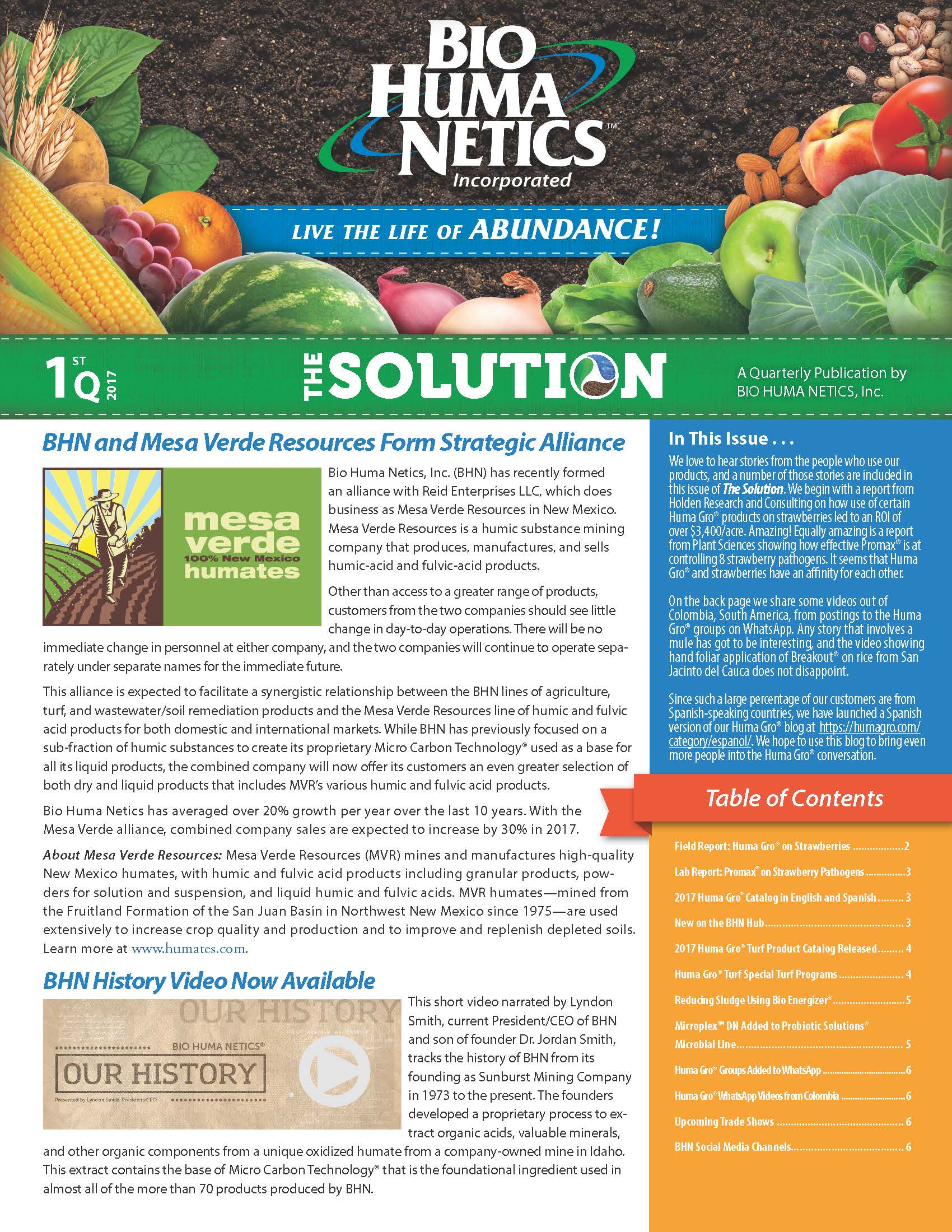
 We love to hear stories from the people who use our products, and a number of those stories are included in this issue of The Solution. We begin with a report from Holden Research and Consulting on how use of certain Huma Gro® products on strawberries led to an ROI of over $3,400/acre. Amazing! Equally amazing is a report from Plant Sciences showing how effective Promax® is at controlling 8 strawberry pathogens. It seems that Huma Gro® and strawberries have an affinity for each other.
In our Probiotic Solutions® section, we report on a case study involving a small town in New Mexico that was in need of reducing the sludge in its wastewater treatment system lagoon in order to meet state requirements. After 300 days of using Bio Energizer®, sludge was reduced to the point where the town had regained capacity to better handle the incoming flow and meet its permit requirements without dredging.
On the back page we share some videos out of Colombia, South America, from postings to the Huma Gro® groups on WhatsApp. Any story that involves a mule has got to be interesting, and the video showing hand foliar application of Breakout® on rice from San Jacinto del Cauca does not disappoint.
We also announce new Huma Gro® catalogs in English and Spanish, an updated Huma Gro® Turf catalog, and the launching of a Spanish version of our Huma Gro® blog at https://humagro.com/category/espanol/: We hope to use this blog to bring even more people into the Huma Gro® conversation.

Related Posts

From the Field: Exploring the Impact of Biostimulants in Asia
Last June, I had the privilege of visiting parts of Asia to attend a conference hosted by one of our distributors. The event brought together ag experts, farmers, and researchers from different parts of the world to discuss the future of farming. I was excited to collaborate with them all and little did I know,

This Week in Ag #33
In commodity crop production, we talk a lot about bushels per acre. Because that’s how farmers get paid. But what exactly does bushels per acre mean? A bushel is the unit of measure we use in the USA (other parts of the world use tons or metric tons) to calculate yield, verify shipments and set pricing standards for crops such as corn, soybeans, wheat, canola, rice and sorghum. There’s a good chance your grandparents had a bushel basket laying around their house, garage, or barn. If you were to fill that basket to the brim with corn, you’d have one bushel’s worth.

From Afterthought to Essential: Fred Nichols on the Micronutrients Market
In a recent interaction with CropLife, Fred Nichols, Chief Marketing and Sales Officer at Huma, shared his views on the micronutrients market. His key thoughts were featured in a special report that highlights how these essential nutrients are rapidly gaining recognition in the agriculture industry. Micronutrients play a key role in promoting the strong, steady