
Huma Pro® Stimulates Rhizophagy Cycle of Microbes to Increase Root Growth, Rutgers Univ.
Conducted by: James White, PhD, Rutgers University
Huma Gro® Products: Huma Pro®
 OBJECTIVE
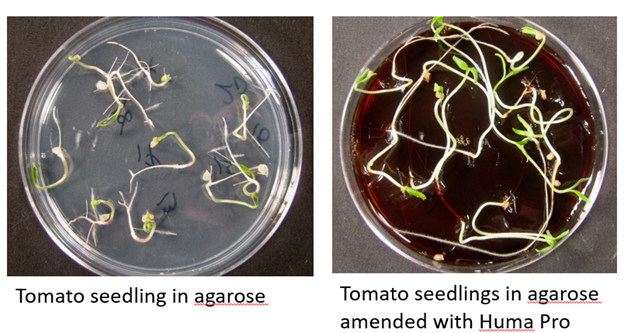
The purpose of this research project was to evaluate how humic acids stimulate microbial activity and initiation of the rhizophagy cycle (in which plants cultivate microbes on their roots and then absorb them to extract their nutrients). Huma Gro® Huma Pro®, a liquid 6% humic acid product, was used as the humic acid biostimulant source.
MATERIALS AND METHODS
Huma Pro®, a 6% liquid humic acid, was incorporated into agarose at concentrations of 0%, 0.01%, and 0.10% humic acids. Seeds of tall fescure, annual bluegrass (Poa annua), and beefsteak tomato were surface disinfected in 3% NaOCl for 30 minutes to reduce microbial load on seedlings. Seeds were germinated and grown for 6 days on agarose (a polysaccharide derived from seaweed) with and without the Huma Gro® product.
CONCLUSIONS
Huma Pro® promotes seedling development in the seedlings tested. Root length in seedlings treated with Huma Pro® increased 73% (tomato) to almost 300% (tall fescue), roots growing downward increased 7 percentage points (tomato) to almost 75 percentage points (bluegrass), and shoot length increased 80% for tall fescue. Huma Pro® acts to stimulate the root microbiome and shows evidence of stimulating the rhizophagy cycle. Stimulation of the rhizophagy cycle in plants should result in increased nutrient absorption in plants.
Click HERE to read the full report.

Related Posts

Promax®: A Proven Soil Biopesticide
OMRI-Listed Huma Gro® Promax® is a soil-applied fungicide and nematicide used as a preventive and a curative agent. It is recommended for the control of many fungal diseases in the soil, as well as plant parasitic nematodes in a wide range of crops.
This Week in Ag #65
“Anticipation” is a famous song from Carly Simon (which also became the advertising anthem for Heinz ketchup). But it could also be the theme for how farmers feel from the moment they drop their planter. My first year of farming on my own, I waited over three nail-biting weeks for my soybeans to emerge. This year,
This Week in Ag #55
While farmer sentiment may be down, their appetite for new information is not. Initial estimates had last week’s Commodity Classic drawing record crowds, with projections of 11,000 attending the event in Houston.