
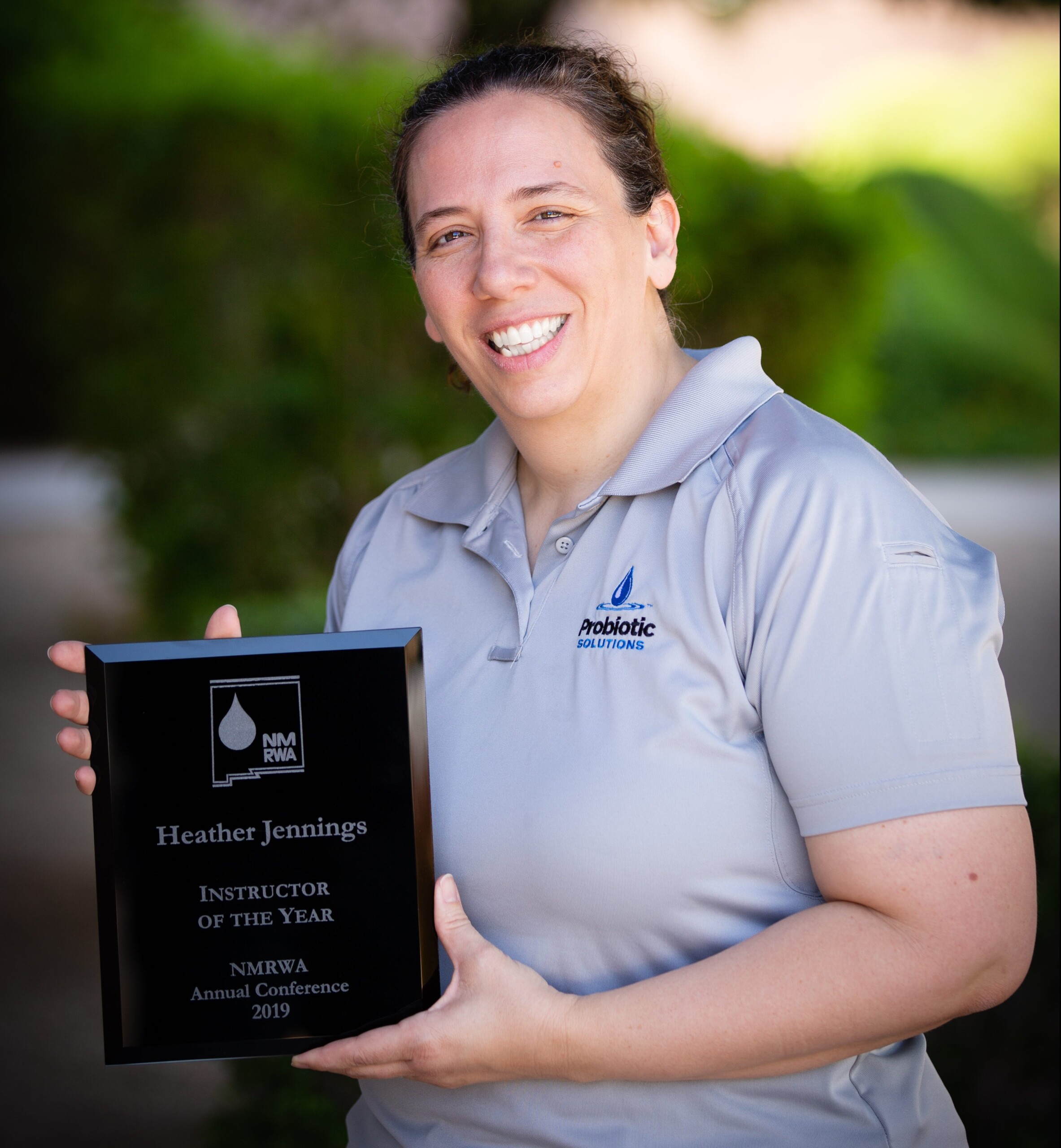
Heather Jennings, Probiotic Solutions® Project Engineer
By Jael Batty
Bio Huma Netics, Inc. congratulates Heather Jennings, Project Engineer for Probiotic Solutions®, who was awarded Instructor of the Year at the New Mexico Rural Water Association (NMRWA) Conference on April 10. Ms. Jennings, who has been training and presenting for five and a half years, teaches basic and advanced wastewater math for certification, a course on microbes, and a nitrification/denitrification course.
NMRWA is a non-profit organization with over 480 water and wastewater system members, representing over 1,297,000 New Mexicans. NMRWA strives to provide the highest quality training and technical assistance and to represent the legislative and regulatory interests of its members.
Ms. Jennings truly enjoys working with NMRWA. “They have a great sense of community. They help each other––there’s no competition. It’s a very good community––a great group of people––that strives to better the water quality in New Mexico.”
Ms. Jennings has been with BHN since 2015. She has a BS in Chemical Engineering from Brigham Young University and has 16 years of engineering experience.
Probiotic Solutions® is the BHN soil and wastewater bioremediation division that assists industries such as food processing, municipal wastewater, pulp and paper, chemical refineries, and others who use water in their processes to treat and return safe, clean water to the environment.

Related Posts

“Trust but Verify”: China’s New Soybean Deal
China’s renewed commitment to purchase millions of tons of U.S. soybeans has farm country buzzing with optimism. But as past trade deals have shown, promises from Beijing don’t always sprout into reality.

Advantages of Micro Carbon Technology®
Bio Huma Netics, Inc. products are manufactured with our exclusive, proprietary Micro Carbon Technology® which is our process of “complexing” small molecules containing carbon to nutrients. These ultra-fine molecules are excellent nutrient carriers that enable more efficient nutrient absorption. This Micro Carbon Technology® makes HUMA GRO® nutrients much more effective and efficient than any other nutrient

The South Is Sweating and So Is The Corn
Just step outside. It's brutal. You’ll instantly know it’s “sweating season” across the South and much of the Midwest. Sure, temperatures are hot, consistently now in the upper 90s across the Delta. But it’s the humidity that instantly gets your attention and triggers sweat glands overload. The dew point - aka "the misery index" - indicates the temperature where dew forms: the higher the dew point, the more moisture is in the air. The National Weather Service defines dew points above 75 degrees as “oppressive.” That’s where we’ve consistently been across the Delta; most days reaching the upper 70s.