
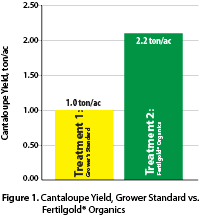
 In this study of Fertilgold® Organics macronutrient (Fertilgold® 3-2-4) and micronutrient (Fertilgold® Micros I) liquid products compared with a grower’s standard treatment on organic cantaloupes applied under field conditions in Arizona, the Fertilgold® Organics treatment powered by a proprietary Micro Carbon Technology® resulted in a 120% yield increase with a 3-to-1 return on investment (ROI).
The research, conducted by Helena Agri-Enterprises at The University of Arizona Yuma Agricultural Center, was conducted as a randomized complete block design with five replications. Each replication consisted of 30 feet long by 80 inches wide beds. Treatments were applied to cantaloupe (Cucumis melo cantaloupensis) cultivar ‘Caribbean gold.’
Download/read the complete report here.

Related Posts

This Week in Ag #25
36 years ago, a wide-eyed intern walked into the office of Indiana Prairie Farmer magazine. It was a baptism by fire. Paul Queck, the seasoned editor, told him, “We’d like to have you take a shot at writing what we hope to be the cover story for July. Since you’re only here for a few months, we

BHN Earns 2019 Biostimulant Industry Impact Award
Bio Huma Netics, Inc. (BHN), located in Gilbert, Arizona, is the recipient of the 2019 Biostimulant Industry Impact Award. The award was presented at Biostimulant CommerceCon in Atlantic City, New Jersey, by AgriBusiness Global and its parent company, Meister Media Worldwide. This prestigious annual award is given to the company that a panel has judged

Microorganisms: The Living Engine of Soil—Part 2
In Part 2 of this series, we look at Plant-Microbial Interactions.