
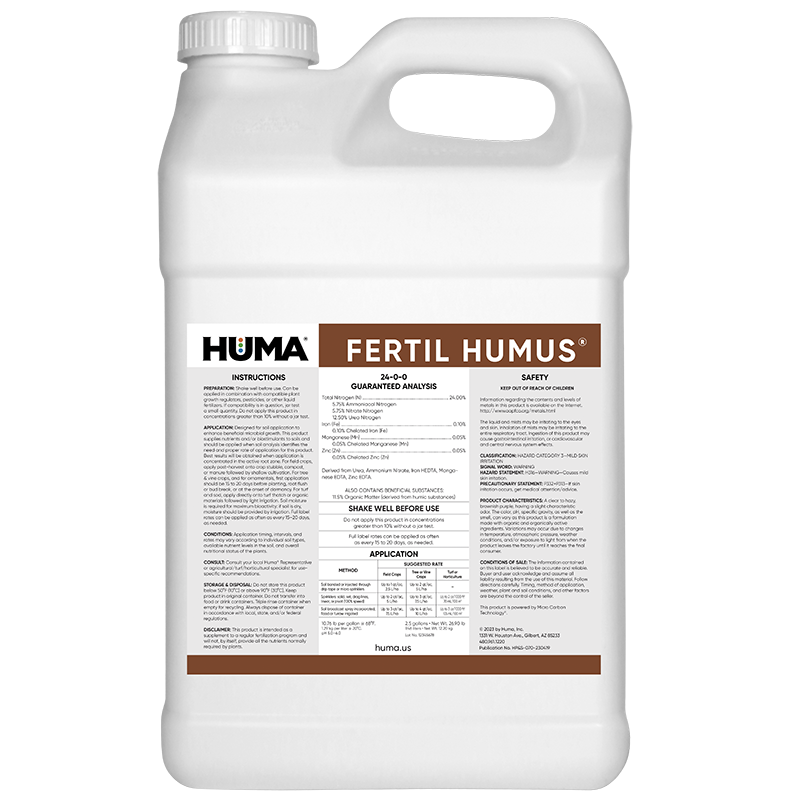
FERTIL HUMUS
Benefits of Use:
- Promotes decomposition of organic residues in soil
- Enhances nutrient recycling from organic matter
- Improves overall soil health and structure
- Buffers harsh chemicals and helps break down soil toxins
- Increases soil water retention
- Stimulates healthy root growth
Deficiency Symptoms—When to Apply:
- Poor or imbalanced soil biology
- Slow decomposition of organic matter
- Sandy soils in need of stabilization through humus formation
- Poor water infiltration or retention
- Presence of chemical residues or soil toxins
FAQs
Related Videos
Huma Gro® Agricultural Products Increase Crop Yield in Mid-South US
Huma Gro® fertilizers and crop treatments increase harvest and profit, control soil salinity, and manage crop disease worldwide. Unlike other farm products, Huma Gro® farming products with Micro Carbon Technology® are more efficient. Huma Gro®
Learn More
Huma Fertil Humus: Soil Fertility Product
A 24-0-0 liquid fertilizer for building soil humus. Aids in the decomposition of organic materials in the soil. Increase soil water retention and buffer plants from chemical residue in the soil
Learn More
Related Case Studies

Fall Soil Application of Fertil Humus® Increases Illinois Corn Yield and ROI
Background Feeding beneficial soil fungal activity can enhance aerobic decomposition of organic matter and build a humus-rich soil that releases nutrients tied up in crop residues. This can positively impact crop yield and lead to a higher return on investment. Objective The objective of this study was to observe how a fall application of Huma®

Effects of Huma® Products on N & P Stabilization in Sandy Soil
Objective To demonstrate the effects of Huma® products X-Tend®, Fertil Humus®, Fertil Soil®, and Zap® on the reduction of nitrogen and phosphorus leaching in Immokalee sandy soils. Background The leaching of nitrogen and phosphate fertilizers presents an ongoing problem in Florida soils. Agricultural amendments that reduce leaching when applied to soils or when mixed with

Fertil Humus® Soil Amendment Trial for Water Infiltration
Objective This field trial assessed the benefits of moisture infiltration enhancement that may be provided by the product Fertil Humus® at selected rates and timings. Materials & Methods The plot site selected for this trial was located in the southern portion of the Columbia Basin in Washington State. The Russet Burbank potato field was pivot-irrigated
Related Blog Posts

This Week in Ag #25
36 years ago, a wide-eyed intern walked into the office of Indiana Prairie Farmer magazine. It was a baptism by fire. Paul Queck, the seasoned editor, told him, “We’d like to have you take a shot at writing what we hope to be the cover story for July. Since you’re only here for a few months, we

This Week in Ag #52
What are farmers doing during these cold winter days? If they farm in the Midwest, they may be laying tile. I realize this may be a foreign concept to my friends in the west, but in many areas of the Corn Belt, you must often move water out of your fields. In heavier soils, excessive rainwater can remain

The South Is Sweating and So Is The Corn
Just step outside. It's brutal. You’ll instantly know it’s “sweating season” across the South and much of the Midwest. Sure, temperatures are hot, consistently now in the upper 90s across the Delta. But it’s the humidity that instantly gets your attention and triggers sweat glands overload. The dew point - aka "the misery index" - indicates the temperature where dew forms: the higher the dew point, the more moisture is in the air. The National Weather Service defines dew points above 75 degrees as “oppressive.” That’s where we’ve consistently been across the Delta; most days reaching the upper 70s.
Related Products
D-FEND
D-FEND®, carbon-complexed with Micro Carbon Technology®, is a foliar formulation of nutrients and refined plant oils that facilitate nutrient uptake...
OM MICROS
Carbon-complexed with Micro Carbon Technology®, OMRI-Listed® Huma's OM MICROS is highly stable liquid organic micronutrient formulation that is balanced for...
MAX PAK
MAX PAK® is a liquid micronutrient formulation containing a carbon complexed, highly stable source of many important micronutrients. MAX PAK...