
CROP-GARD
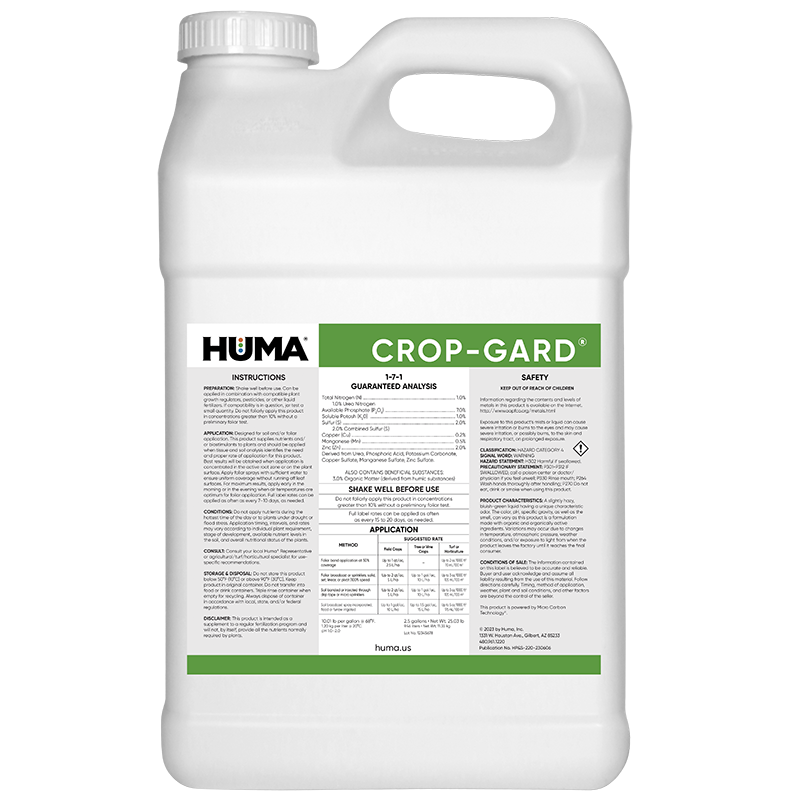
Benefits of Use:
- Enhances natural plant ability to tolerate environmental stresses through improved nutritional balance
- Will tank mix with sulfur-copper fungicidal sprays and most chemical fungicide formulations
- Provides essential plant nutrients
- Can be used to carry any combination of Huma® nutrients
- Minimizes leaf burn or phytotoxicity associated with foliar nutrient sprays
- Usually eliminates the need for wetting agents or sticker spreaders
Deficiency Symptoms—When to Apply:
- Yellowing of leaves
- Plants weakened due to stress/disease
- Poor plant vigor
FAQs
Related Case Studies

PROUD 3 Fungicide Replacement
Background Huma® fungicide programs with Micro Carbon Technology® provide growers with effective options that can replace synthetic fungicides with a more sustainable and environmentally friendly approach, while providing excellent control and improving crop health, yield and quality. Objective The focus of this study was to assess if 2 of Huma’s products CROP-GARD® (Growth Manager) and
Related Blog Posts

Why Are Humic Substances Called Acids?
By Richard Lamar, PhD Senior Director of Humic Research Bio Huma Netics, Inc. We are accustomed to seeing humic substances (humic and fulvic) in dry/granular form, and we tend to think of acids as liquids. So why are humic and fulvic substances called acids? All substances, solid AND liquid, have a chemical makeup. An acid

#FarmersMarketWeek: The Shortest Distance to Better Eating
#NationalFarmersMarketWeek: The Shortest Distance to Better Eating What is food really grown for: nutrition, taste, or just to survive a long supply chain? The truth may surprise you. This National Farmers Market Week, we explore why much of our food is grown to be shipped, not savored, and how local farmers' markets offer a fresh, flavorful, and community-powered alternative.

Earth Day: “It’s Getting Better All the Time”
Celebrating Earth Day every April 22 is a great time to pause and reflect: How are we, today, treating the environment and the plants, animals, and people who live in it? What have we accomplished in the past year that makes our planet a better, more sustainable place to live and raise our families? What are our goals for future improvement?
Related Products
BREAKOUT
BREAKOUT®, carbon-complexed with Micro Carbon Technology®, is designed to feed the natural metabolic process within the plant for enhanced bud...

OM LIQUID HA 16
Huma's OM LIQUID HA 16 is OMRI-Listed® for organic farming and carbon-complexed with Micro Carbon Technology®.
LUCKY 7
LUCKY 7® is a broad-spectrum liquid nutrient formulation carbon-complexed with Micro Carbon Technology®. It's a complete nutrient package containing most macro-...