
IRO-MAX
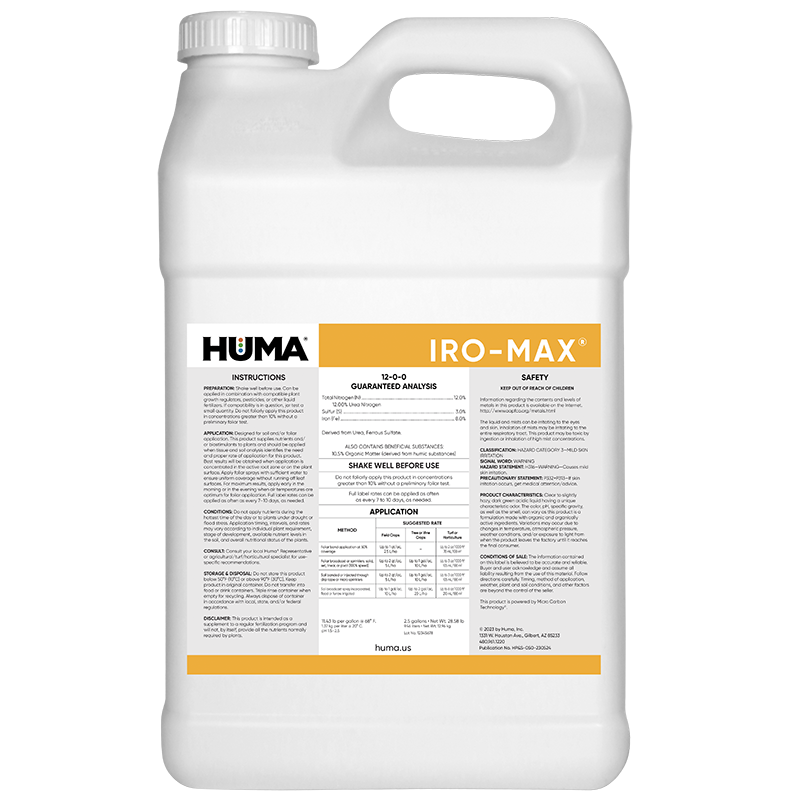
Benefits of Use:
- Iron is required by plants for the formation of chlorophyll.
- Iron is a component of enzymes that activate other biochemical processes within plants such as respiration, symbiotic nitrogen fixation, and energy transfer.
- IRO-MAX® relieves chlorotic symptoms of iron-deficient plants.
Deficiency Symptoms—When to Apply:
- Plants develop severe chlorosis, or a yellowing or “bleaching” of leaf tissue with veins remaining green
- Severe iron deficiencies result in stunted growth
- In grain crops, leaves will show chlorotic or yellow striping
- High pH, excess bicarbonate, calcium, magnesium, and/or phosphate
- High levels of nitrate, over-irrigation or poor drainage, poor aeration, plant viruses, root pruning, or nematode damage
- Deficiencies of potassium and calcium
FAQs
Related Videos
Huma® Micronutrients and Secondary Macronutrients
Huma liquid micronutrient and secondary macronutrient fertilizers with Micro Carbon Technology (MCT) are extremely efficient. MCT improves nutrient uptake so you can get the most out of your crops. Deliver micronutrients and secondary macronutrients exactly
Learn More
Related Case Studies

PROUD 4 Demonstrates Broad-Spectrum Control of Plant Diseases
[fusion_builder_container type="flex" hundred_percent="no" hundred_percent_height="no" min_height_medium="" min_height_small="" min_height="" hundred_percent_height_scroll="no" align_content="stretch" flex_align_items="flex-start" flex_justify_content="flex-start" flex_wrap_medium="" flex_wrap_small="" flex_wrap="wrap" flex_column_spacing="" hundred_percent_height_center_content="yes" equal_height_columns="no" container_tag="div" menu_anchor="" hide_on_mobile="small-visibility,medium-visibility,large-visibility" status="published" publish_date="" class="" id="" html_attributes="" spacing_medium="" margin_top_medium="" margin_bottom_medium="" spacing_small="" margin_top_small="" margin_bottom_small="" margin_top="" margin_bottom="" padding_dimensions_medium="" padding_top_medium="" padding_right_medium="" padding_bottom_medium="" padding_left_medium="" padding_dimensions_small="" padding_top_small="" padding_right_small="" padding_bottom_small="" padding_left_small="" padding_top="" padding_right="" padding_bottom="" padding_left="" link_hover_color="" link_color="" border_sizes="" border_sizes_top="" border_sizes_right="" border_sizes_bottom="" border_sizes_left="" border_color=""

Huma® Breakout® Improves Blueberries Yield in Northwest, With Increased Yield and ROI of 7:1
Background Oregon is one of the top blueberry producing states. Increasing blueberry production in an economical way with a high return on investment will significantly benefit blueberry growers. Breakout®, a yield-enhancing product, has increased the yield of fruit producing crops such as tomatoes. Objectives This field study aimed to test the effects of Huma® Breakout®on

Huma® Program Increases Soybean Yields 21%, With an ROI of 389%
Objective This field trial assessed the effects of 2 foliar applications of 2 combinations of Huma® products versus a control during the growing season on the yield of soybeans (Glycine max, variety AG48X7) when compared with the grower’s standard crop nutrition program. Materials & Methods This trial was set up in a complete randomized-block design




Related Blog Posts

This Week in Ag #27
Just as the seasons inevitably turn, so does the farming landscape within a tight-knit rural community. That reality hit close to home for me last Thursday with the passing of my uncle, Gary Nichols. He and my father farmed together for decades, and like most farming families, Uncle Gary was a solid fixture in my life,

The Story Behind the Pink Tickets
For most people, fall means changing leaves and football. For me, it means pink scale tickets, old grain trucks and memories of growing up around harvest. It's a look back at family traditions, country grain elevators and the hardworking people who keep harvest moving.

This Week in Ag #42
What’s fueling regenerative agriculture? Sustainability, climate concerns, ESG-driven investors, soil health and heightened crop input costs are all major contributors. Another may be the shift in demographics. Millennials (born 1981-1996) recently passed baby boomers as the USAs most populous generation. And more than half of the US population is now comprised of millennials or younger. With a shift in population, and shift in culture, comes a shift in buying patterns.
Related Products
OM MAG
Carbon-complexed with Micro Carbon Technology®, OMRI-Listed® OM MAG is an organic magnesium nutrient. Huma's OM MAG ensures maximum assimilation of...
OM BORON
Carbon-complexed with Micro Carbon Technology®, OMRI-Listed® OM BORON is an organic boron nutrient. It ensures maximum assimilation of boron, which...
OM SOLUBLE POWDER
OMRI-Listed Huma® OM Soluble Powder is a water-soluble modified potassium humate powder derived from humic ore that is designed to be...