
K HUME OM
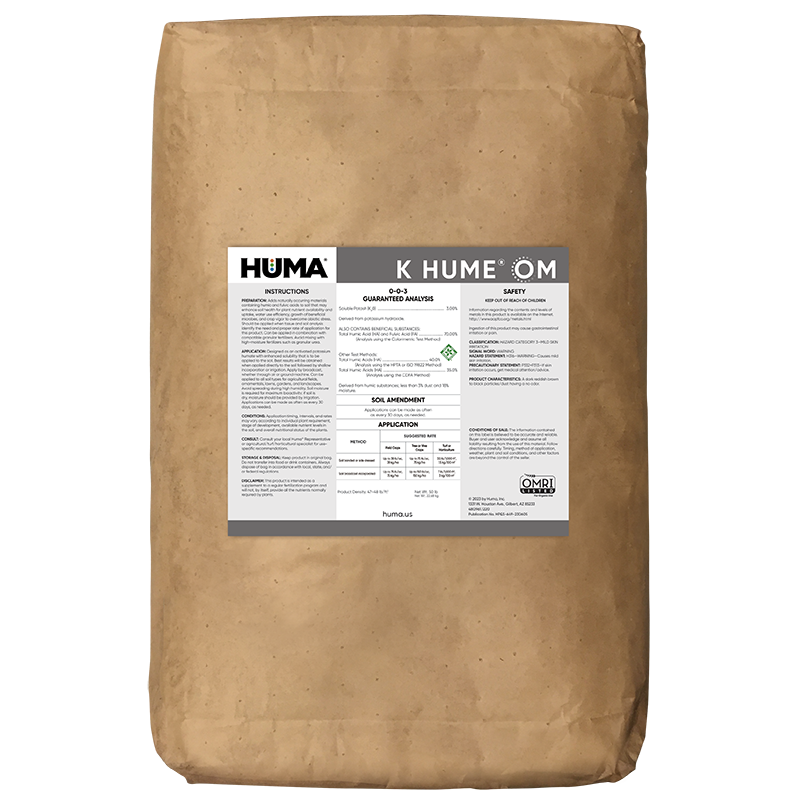
Benefits of Use:
- Uniform granular size promotes even coverage/distribution of humic substances for short-term carbon benefit
- With the potassium coating, becomes a short-term soil organic-matter builder
- Increased water penetration
- Increased flocculation of clays
- Promotes conversion of fertilizer into plant-available food
- Increases soil nutrient mineralization
- Short-term soil microbial activation
FAQs
Related Videos
Huma Minute – Huma K-Hume OM with Barrett Smith
Huma Agronomist Barrett Smith discusses K-Hume OM and how it differs from a regular granular humic product.
Learn More
Huma Minute – What is Humic Acid with Cory Ritter
Huma Mid-West Regional Sales Manager Cory Ritter discusses the different types of humic acids and what they do for your plants.
Learn More
Huma Minute – Humate Application Rates with Cory Ritter
Huma Mid-West Regional Sales Manager Cory Ritter discusses humate application rates and why there is not a one-size fits all rate.
Learn More
Related Case Studies

Humic Products Increase Soybean Yield In Iowa
Background Scientific research shows humic and fulvic acids can have a biostimulant effect on plant root growth and mass, nutrient availability and uptake, and crop yield and quality. Objective The objective of this study was to compare and contrast the immediate effects that three types of humic products from Huma®, Inc., have on soybean yield.

Humic Products Increase Iowa Corn Yield
Background Scientific research shows humic and fulvic acids can have a biostimulant effect on plant root growth and mass, nutrient availability and uptake, and crop yield and quality. Objective The objective of this study was to compare and contrast the immediate effects that three types of humic products from Huma®, Inc. have on corn yield.
Related Blog Posts

From Afterthought to Essential: Fred Nichols on the Micronutrients Market
In a recent interaction with CropLife, Fred Nichols, Chief Marketing and Sales Officer at Huma, shared his views on the micronutrients market. His key thoughts were featured in a special report that highlights how these essential nutrients are rapidly gaining recognition in the agriculture industry. Micronutrients play a key role in promoting the strong, steady

This Week in Ag #87
Seasonal migration isn’t just for the birds. Or the snowbirds heading to Arizona. Some of nature’s most majestic and essential creatures are now making their way southward: butterflies. These winged beauties are prolific pollinators of crops, landscapes, wildflowers and gardens. Three-quarters of all food crops worldwide are somewhat or heavily dependent on pollinators such as butterflies. Monarch

A Familiar Story: Margins Squeeze, Resilient Farmers
Rising input costs and stagnant crop prices are squeezing farm margins to their widest gap in a decade. Yet despite the pressure, farmer sentiment remains surprisingly strong as growers look for smarter, more efficient ways to improve their operations rather than simply cutting rates.
Related Products
D-FEND
D-FEND®, carbon-complexed with Micro Carbon Technology®, is a foliar formulation of nutrients and refined plant oils that facilitate nutrient uptake...
OM GREENS
Huma's OM GREENS is a natural humic and fulvic acid product processed from naturally occurring, oxidized humic substances. It provides a...
SUPER NITRO
SUPER NITRO®, carbon-complexed with Micro Carbon Technology®, is a nitrogen source that can be foliar-applied, according to label directions, without...