
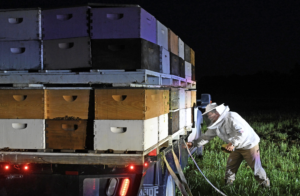
When you’re carving your Halloween pumpkins this week, be sure to thank a bee. That’s because pumpkins are not self-pollinating plants. Unlike cotton and soybeans, where pollen produced within a flower fertilizes the ovary of the same flower on the same plant, pumpkins have specific male and female flowers across their vines. So they need bees to carry pollen between the flowers. Pumpkin growers will rent bee colonies during the growing season to ensure better pollination and higher yields.
October is, of course, National Pumpkin Month. These distinctive orange orbs are the ultimate seasonal crop – 90% of pumpkin products are sold during this four-month window of September-December. Each year US farmers produce about 1.5 billion pounds of pumpkins. The top-producing pumpkin state is Illinois, with the central Illinois community of Morton boasting pumpkin capital of the world, thanks to a large Libby’s processing plant. Pumpkins are composed of 90% water, and they’re loaded with nutrients. Their seeds even act as dewormers for livestock and pets. Sadly, since 85% of pumpkins are grown for decoration, they are also the most wasted crop, as the vast majority of old Jack-o-lanterns end up in landfills. So here’s a tip that I’ve used for years: chop up your jack-o-lanterns and place them in your gardens and flower beds. They are an excellent source of plant nutrition.
It’s cover crop season. Most cover crops get seeded right after harvest (although technology such as robots and drones, as well as aerial application, is allowing farmers to become more creative when they plant covers). Momentum is growing for growing covers. Studies show over half of all large-scale farms are now using the cultural practice; with over 40% of them being newbies, having adopted the practice within the past five years. Yet among all users, nearly half plant them on less than 25% of their acres, while only 16% are all-in and plant them on over half their acres. Improving soil health and erosion control are the top reasons growers cite for planting covers, which suggests they are most often sown on marginal soils. But how do cover crops impact fertile black soils? A six-year study by the University of Illinois, home to best soils in the world (yes, I’m guilty as charged with bias), revealed a 9-bushel per acre yield decrease on corn fields that used covers vs. those without, 206 compared to 215. Yet on the 5% lowest yielding fields, covers produced a 12-bu/A yield advantage. Soybean yields were less impacted, with covers showing a 2-bu/A decline overall and a 1-bu/A decrease on the 5% lowest yielding fields. This may explain why you don’t see many green fields in the late fall/early spring while traveling across the Prairie State. Of course, there are several advantages to planting the likes of cereal rye, oats and/or hairy vetch ahead of next year’s crop. Not the least of which are premiums offered by federal, state and private company programs. ADM is offering up to a $25/A premium for employing the practice, while discounts on crop insurance premiums are offered in some areas.
We’re also in the middle of fall calving season. As the name implies, this is the time when beef cows are birthing offspring in pastures. About one-quarter of calves are born in the fall. Calving dates don’t occur by accident, they are planned. Cattle producers will introduce bulls into their herds at specific times with birthing dates in mind. The gestation period for cows is basically the same as for humans. By calving in the fall, producers hope to take advantage of historically higher demand and prices for their weaned calves when they sell them in the spring. They also have more predictable weather. The downside is feeding costs. Lactating animals require much more food, and in the winter this means feeding hay, whereas cows calving in the spring can often rely on grazing grasses.
On Saturday we reach the average “first frost date” at my home in west Tennessee, which is November 4 (it’s November 29 at Huma’s base in Gilbert, Arizona). Right on cue, we’re expecting nighttime lows below freezing mid-week (I’ll be covering my still-producing vegetables and mums). A frost date this late should pose little threat to area crops, as most of our crops are either harvested or fully mature and ready for harvest. The exception is cotton. That’s the crop Southern farmers always worry about. A frost (32 degrees or below for a few hours) will shut down the plant and prevent any unopened bolls from opening. That happened throughout the Mid-South last season. Cotton has a very long growing season, which is why you only see it in the South. Farmers in the Missouri Bootheel will plant shorter season varieties and cross their fingers.
Our friend and social media maven @AgWithEmma is featured in this video story by Farm Journal.

Related Posts

Hats Off to Farmers, Today and Every Day
Agriculture is one of the world’s oldest industries. In fact, many countries’ economies still depend on the agricultural industry. Today, on October 12, we recognize the hard work that goes into feeding a nation. Previously known as Old Farmers Day, National Farmers’ Day dates back to the 1800s, a time when a higher percentage of

America’s Shrinking Wheat Crop
America is projected to harvest its smallest wheat crop in decades as drought, declining acreage and rising input costs pressure growers across the country. While consumers continue seeing higher grocery prices, the price farmers receive for wheat tells a very different story.

BHN Approved to Import Fertilizers to Brazil
Bio Huma Netics, Inc., producer of Huma Gro® and Fertilgold® Organics liquid crop nutrition and protection products, has been granted an unlimited import license to bring fertilizers into Brazil for commercial sale.