
OM BORON
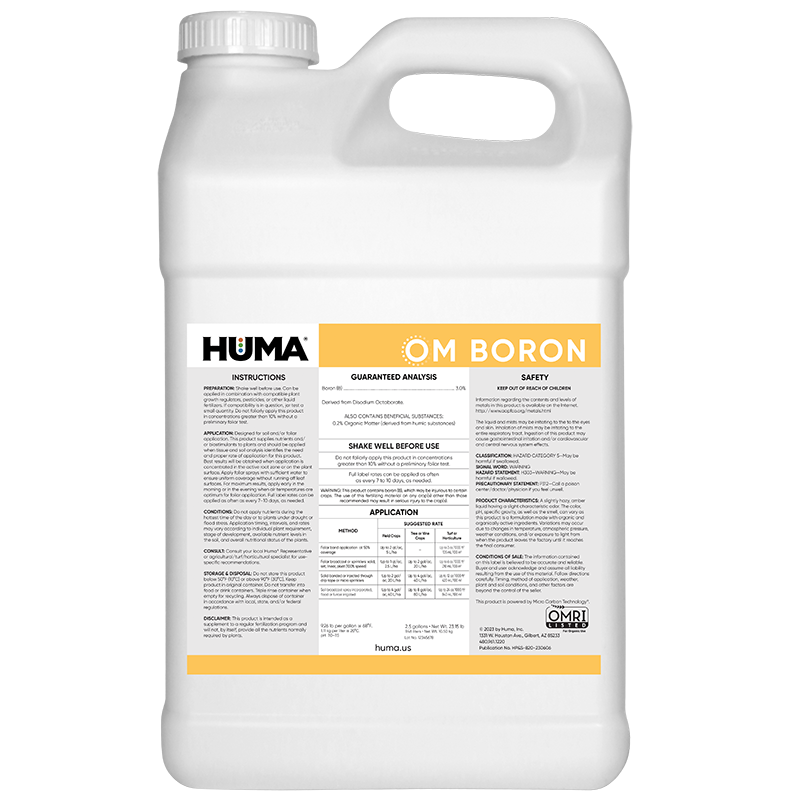
Benefits of Use:
- Effectively treats boron deficiency symptoms, supplying boron nutrition necessary for metabolic activity, proper growth, and maturation
- Functions with calcium to form an “intercellular cement” to maintain plant structural integrity
- Provides quick crop response and can be applied just prior to actual crop need
- Can be applied foliarly (according to label directions) without risk of phytotoxicity
- Can be effectively tank-mixed with other organic crop inputs
- Resists tie-up in the soil and remains available through the plant root system
FAQs
Related Case Studies

Huma® Promax® and Zap® Decrease Charcoal Rot in Florida Strawberry, With Increased Yield and ROI of 10:1
Background Charcoal rot, caused by the soil-borne pathogen Macrophomina phaseolina, can be a significant threat to strawberry production. Two Huma® products, Promax® and Zap®, had previously been shown to be successful in managing soil-borne diseases in strawberries. Objectives The primary objectives of this study were to assess the efficacy of Promax® and Zap® in reducing

Huma Pro® Mix, pH-Stable Liquid Humic Acid Product, Increases Corn Yield
Conducted by: Bruce Kirksey, PhD, Agricenter International, Memphis, Tenn. Huma® Product: Huma Pro® Mix Background Scientific research shows that humic and fulvic acids are biostimulants—enhancing nutrient availability and uptake, improving plant root growth and mass, and impacting both crop yield and quality. Humic acid products are not all the same. They are marketed in solid

OM 3-2-4 and OM Micros Liquid Fertilizers Increase Organic Cantaloupe Yield 120%
Summary In this study of Huma® organic macronutrient (OM 3-2-4) and micronutrient (OM Micros) liquid products compared with a grower’s standard treatment on organic cantaloupes applied under field conditions in Arizona, the Huma® organic treatments powered by a proprietary Micro Carbon Technology® resulted in a 120% yield increase with a 3-to-1 return on investment (ROI).




Related Blog Posts

1996: The Year Farming Changed Forever
Michael Jordan dominated the court, Friends topped TV ratings, and Tiger Woods was about to change golf. But in agriculture, 1996 marked an even bigger turning point. From GPS yield mapping and Bt corn to Roundup Ready soybeans and the Freedom to Farm Act, discover how one year transformed farming forever.

Mighty Micronutrients – Q&A with CMO Fred Nichols
Fred Nichols, Chief Sales and Marketing Officer at Huma®, shared his perspective in a recent article on micronutrient technology, published in CropLife. In the article, Fred discusses how advancements in micronutrient formulations are meeting increased demand, improving nutrient availability, and enhancing crop performance. Below are the key topics along with Fred’s insights.

Field Trial: X-Tend® Increases Glyphosate Effectiveness
Objective Over the years, some weeds have developed resistance to common herbicides such as glyphosate. To overcome this hurdle, growers may bump up the rates or add other herbicides or products with different mechanisms/modes of action into the tank mix. Such approaches have had mixed results over the long run and have increased the cost
Related Products
OM PRILLED
OMRI-Listed® OM PRILLED is a natural humic and fulvic acid product processed from naturally occurring, oxidized humic substances. It provides...
MicroHumic OM
The Organic Solution for Stimulating Seeds, Soil, and Crops OMRI-Listed as both a soil amendment and as a seed treatment,...
OM COBALT
Carbon-complexed with Micro Carbon Technology®, OMRI-Listed® OM COBALT is an organic cobalt nutrient derived from cobalt sulfate (Co 5.0%, with...