
CALCIUM
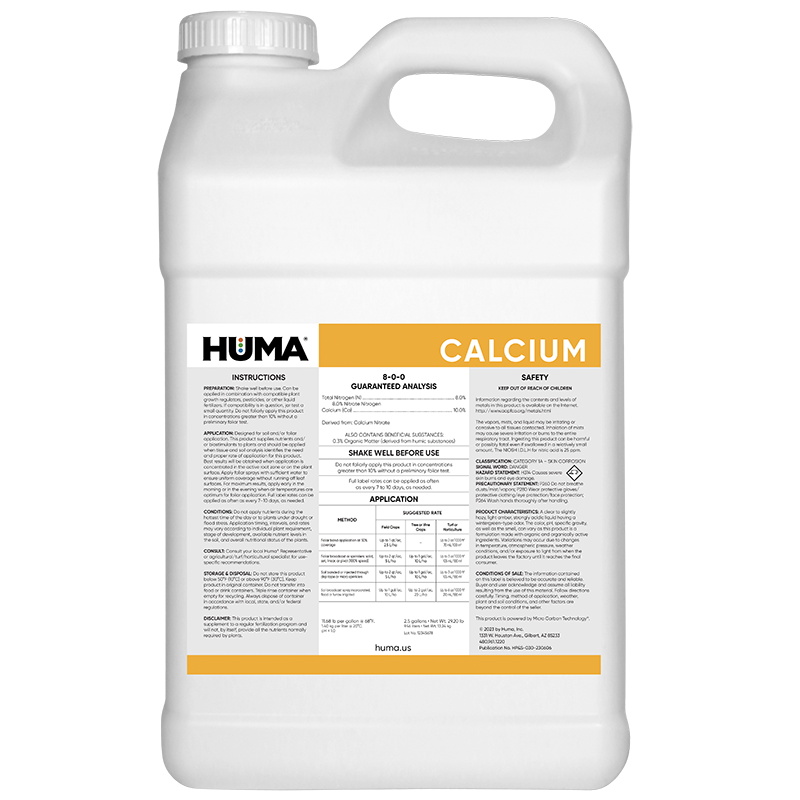
Benefits of Use:
- Increases stalk strength and reduces lodging in grain crops
- Increases shelf life and reduces shipping and storage disorders in fruits and vegetables
- Promotes maturity and improves fiber quality in cotton
- Improves plant tolerance of environmental stresses
- Enhances nodulation in legumes
- Promotes early root growth
- Promotes maturity and viability in seed crops
Deficiency Symptoms—When to Apply:
- Weak stalk and lodging
- Roots short and knotted
- Leaves and terminal buds distorted
- Leaves with wrinkled appearance
- Leaf die-back at the tips and along the margins
- LETTUCE: tip burn, TOMATO/PEPPER: blossom-end rot, CUCUMBER: hollow heart, BROCCOLI: black heart
FAQs
Related Videos
Nutrient Requirements for Pecan Trees
Pecan grower Josh Bowman of First Fruit Orchards discusses macronutrient and micronutrient recommendations and timing for pecan trees.
Learn More
Huma® Micronutrients and Secondary Macronutrients
Huma liquid micronutrient and secondary macronutrient fertilizers with Micro Carbon Technology (MCT) are extremely efficient. MCT improves nutrient uptake so you can get the most out of your crops. Deliver micronutrients and secondary macronutrients exactly
Learn More
Related Case Studies

Huma® Fertilizer Program Improves Potato Yield by 5%, With 200% ROI
Background Huma® liquid fertilizer programs with Micro Carbon Technology® provide growers with efficient crop nutrients via foliar spray or irrigation at the exact time crops need them. Precision timing of efficient nutrition provides better crop yield and quality. Objective The focus of this study was to assess how the efficient Huma® nutritional products affect potato

Huma® and Zia Pueblo Farm Corn Project
Background Many small-scale farms (1-2 acres each) are established in Zia Pueblo community near San Ysidro, New Mexico. Huma® Inc. was asked to establish an experimental farm in the tribal community that could demonstrate the usage of beneficial agricultural inputs producing high-yield crop and preserving the health of the soil. Huma® humic-based products stimulate plant

Recoverable Sugar of Sugar Beets Yield Increased Using Huma® Program, Year 2
Objective This field trial was conducted to observe effectiveness of additional preharvest applications of Huma® products on recoverable sugar of sugar beets and return on investment. Materials & Methods This trial on sugar beet (Beta vulgais vulg. altissima) was conducted in Homedale, Idaho. The crop was seeded on April 18 and was harvested on October


Related Blog Posts

This Week in Ag #55
While farmer sentiment may be down, their appetite for new information is not. Initial estimates had last week’s Commodity Classic drawing record crowds, with projections of 11,000 attending the event in Houston.

The President Who Planted the Future
Before he led a nation, Abraham Lincoln worked the land. This week, we look back at how a farm kid’s firsthand understanding of agriculture helped shape policies, institutions and opportunities that still influence American farming today.

Microorganisms: The Living Engine of Soil—Part 1
In this series, we discuss the many important roles that soil microorganisms play in producing fertile soil and healthy crops.
Related Products
OM POTASSIUM
Carbon-complexed with Micro Carbon Technology®, OMRI-Listed® OM POTASSIUM is an organic potassium product that effectively maximizes potassium uptake by plants....
D-FEND
D-FEND®, carbon-complexed with Micro Carbon Technology®, is a foliar formulation of nutrients and refined plant oils that facilitate nutrient uptake...
SUPER PHOS
SUPER PHOS®, carbon-complexed with Micro Carbon Technology®, can be foliar-applied, according to label directions, without the risk of phytotoxicity. When...