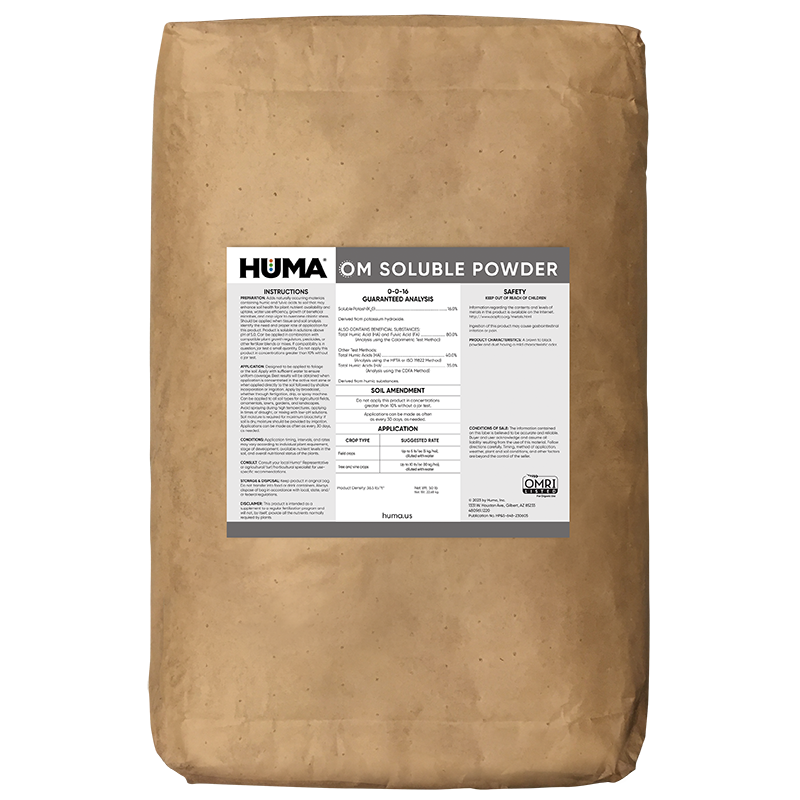
OM SOLUBLE POWDER
Benefits of Use:
- Improves soil structure
- Stimulates microbial growth
- Stabilizes soil pH
- Increases nutrient exchange and retention
- Makes micronutrients more readily available
- Increases root penetration
- Improves nutrient absorption
- Increases stress tolerance
- Improves seed germination
FAQs
Advanced Humic Technology for Healthier Soil
Huma’s OMRI-Listed® OM SOLUBLE POWDER is a water-soluble modified potassium humate powder derived from humic ore that is designed to be mixed in liquid solutions and applied to soil. It is produced using a proprietary extraction, modification, and spray dry process. This process yields a high quality humic substance that, when added to water or other solutions, has a low solution viscosity. It can be blended and pumped easily and will not plug nozzles or gel during storage. In comparison with other dry humate products, it is soluble over a wider range of pH (5.5 and above) and is low in sodium. OM SOLUBLE POWDER is readily bioavailable and is packaged as a fully dissolvable (95% in water) powder. The high carboxyl content improves solubility and ion exchange.
Also contains beneficial substances:
Total Humic Acids (HA)………………………………….40.0%
(Analysis using the HPTA or ISO 19822 Method)
Other Test Methods:
Total Humic Acids (HA)…………………………………. 35.0%
(Analysis using the CDFA Method)
Total Humic Acid (HA) and Fulvic Acid (FA)……… 80.0%
(Analysis using the Colorimetric Test Method)
Derived from leonardite.
PHYSICAL PROPERTIES
Form: Dry granule
Appearance: A brown to black powder and dust having a mild characteristic odor.
Product Density: 36.5 lb/ft3
Net Weight: 55 lb / 25 kg
25 kg. Paper Kraft Bagging – Our 25 kg. bags are “blow-in” type bags with 2 paper layers and an inner layer of impermeable plastic. Air holes in the bags allow the product to be blown in through an opening in the top of the bag. This opening is self-closing when the bag is filled to capacity. 25 kg. bags are stacked on 40×48″ pallets for shipping, with 40 bags to the pallet (2,000 pounds of product per pallet. The pallets themselves weigh 50 pounds). Shrink wrapping of palleted bags is available upon request. The bags are a plain brown paper with no printing. Pre-printed customer bags can be filled upon request.
1 Ton Mini Tote Bags – The most popular method for shipping our products is in mini-bulk bags, each of which holds approximately 1 ton of product. These bags are made of a synthetic material and are resistant to moisture. The bags are “duffel top”, meaning they can be tied closed at the top. A spout on the bottom of the mini-bulk bags is tied closed for filling and can be opened to allow dumping of the product into a hopper or mixer. Straps at the four top corners of the bags allow easy handling with a forklift. We can ship mini-bulk bags on pallets (36×26″) upon request.

OM Soluble Powder Application Rates Chart
Related Videos
Huma Minute – What is Humic Acid with Cory Ritter
Huma Mid-West Regional Sales Manager Cory Ritter discusses the different types of humic acids and what they do for your plants.
Learn More
Huma Minute – Humate Application Rates with Cory Ritter
Huma Mid-West Regional Sales Manager Cory Ritter discusses humate application rates and why there is not a one-size fits all rate.
Learn More
Huma Minute – Humic Acid Testing Methods with Cory Ritter
Huma Mid-West Regional Sales Manager Cory Ritter discusses the differences in the various humic acid testing methods.
Learn More
Related Case Studies

Huma® and Zia Pueblo Farm Corn Project
Background Many small-scale farms (1-2 acres each) are established in Zia Pueblo community near San Ysidro, New Mexico. Huma® Inc. was asked to establish an experimental farm in the tribal community that could demonstrate the usage of beneficial agricultural inputs producing high-yield crop and preserving the health of the soil. Huma® humic-based products stimulate plant
Related Blog Posts
Beating High Phosphorus Prices
Phosphorus prices for 2026 are painful, but cutting fertilizer rates isn’t the only option. By switching to more efficient sources like SUPER PHOS and unlocking tied-up nutrients with K-HUME, growers can stretch their phosphorus dollars while still pushing for top-end yields.

Huma Gro® Testimonial Videos from the BHN 2016 World Conference
At the BHN 2016 World Conference in October we had a chance to sit down with a few of our key distributors and ask them about their experiences with Huma Gro® products. Here are the resulting testimonial videos from distributors in Turkey, Costa Rica, Philippines, and the United States. Adolfo Meneses—representing Agroinnova S.A. in Costa

Live Aid: Music That Fed the World (and Filled My Parents’ Basement)
This Week In Ag #124: Live Aid: Music That Fed the World (and Filled My Parents’ Basement) This past Sunday marked the 40th anniversary of the greatest PR and musical event in history. It was held at Wembley Stadium in London. And at JFK Stadium in Philadelphia. It was viewed by nearly 40% of the world’s population. The event was Live Aid, a benefit concert to raise money and awareness for famine relief in Africa. It was the event that forged a generation, my generation, Gen X. I’ll never forget that day. Dad was among the first in our neighborhood to purchase a satellite dish. I threw a party that day, attended by seemingly every college-aged aggie in the county (or at least dad seemed to think so)
Related Products
ZAP
ZAP® carbon-complexed with Micro Carbon Technology® is an organic-based formulation of nutrients for feeding the native beneficial soil microbial balance....
MicroHumic OM
The Organic Solution for Stimulating Seeds, Soil, and Crops OMRI-Listed as both a soil amendment and as a seed treatment,...
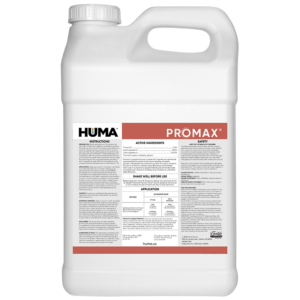
PROMAX
PROMAX® is an OMRI-Listed®, EPA-exempt crop protection product. It is a protective and curative pesticide recommended for control of plant...