
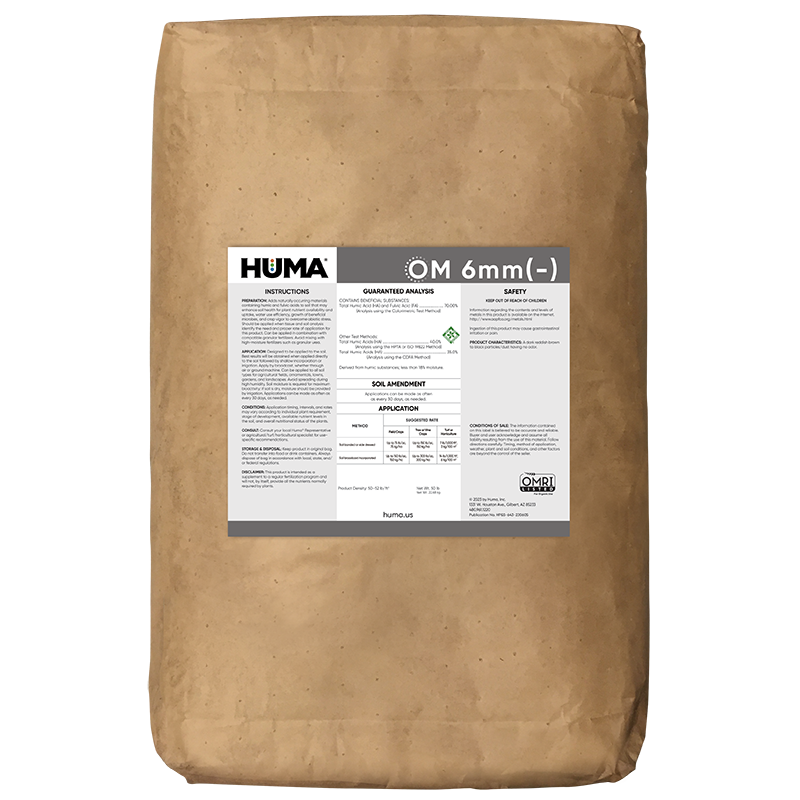
OM 6 mm(-)
Benefits of Use:
- Variable granular size promotes even coverage/distribution of humic substances for sustainable carbon benefit
- Long-term soil organic-matter building
- Increased water penetration
- Increased flocculation of clays
- Promotes conversion of fertilizer into plant-available food
- Increases soil nutrient mineralization
- Sustainable soil microbial activation
FAQs
Related Videos
Huma Minute – What is Humic Acid with Cory Ritter
Huma Mid-West Regional Sales Manager Cory Ritter discusses the different types of humic acids and what they do for your plants.
Learn More
Huma Minute – Humate Application Rates with Cory Ritter
Huma Mid-West Regional Sales Manager Cory Ritter discusses humate application rates and why there is not a one-size fits all rate.
Learn More
Huma Minute – Humic Acid Testing Methods with Cory Ritter
Huma Mid-West Regional Sales Manager Cory Ritter discusses the differences in the various humic acid testing methods.
Learn More
Related Case Studies

Huma® Nutrient and Fumigation Replacement Program Increases Strawberry Yields
Objective This field trial assessed the effects on strawberry yields of replacing field fumigation with periodic applications of Huma® Promax® and Zap® and replacing a grower’s standard fertilizer program with irrigation-applied Ultra-Precision™ blended liquid Huma® crop nutrition products. Materials & Methods This trial was conducted in Arroyo Grande, Calif., using Portola strawberries planted in 40’

Huma® Breakout® Increases Cotton Production 15% for Johnson Farms
Objective A field trial was conducted to compare using the treatment product Furst™ alone versus using Huma® Breakout® + Furst™ on a Johnson Farms Inc. cotton crop in Glendale, Arizona. Materials & Methods A field of cotton was split into two sections. Section 1 (35.01 acres) was treated with 32 ounces (1 quart) of Furst™

Huma® Breakout® Increases Processing-Tomato Yield With 8:1 ROI
Objective In this study, the Huma® growth manager product Breakout® was evaluated in terms of its effects on yield and quality of processing tomatoes. Materials & Methods In cooperation with the University of California, processing tomato seedlings were transplanted on a farm in Central Valley of California near Patterson on April 4 and then harvested


Related Blog Posts

This Week in Ag #13
Corn came screaming out of the ground in just five days on my farm at Agricenter International in Memphis. Other than the seed and herbicide, I’m using 100% Huma® products. My belief is that you don’t just farm the crop, you farm the soil. These Mid-South soils have low organic matter levels, so the pre-plant application

Video: Earth Day, 2022
On April 22, let's celebrate by doing something good for Planet Earth. There are enormous environmental challenges ahead, but also great opportunities.

Save 25% on Phosphorus Fertilizer with Huma SUPER PHOS®
Phosphorus fertilizer prices are at record highs, but Huma Super Phos® offers a smarter solution. With Micro Carbon Technology®, Super Phos® delivers higher nutrient efficiency while saving growers up to 25% per pound of P₂O₅ compared to DAP or MAP.
Related Products
KLEENUP
KLEENUP™ is a nutrient and soil surfactant formulation with Micro Carbon Technology® that creates a favorable soil environment, improves aeration,...
JACKPOT
JACKPOT® , carbon-complexed with Micro Carbon Technology® , is a concentrated formulation of potassium and boron that feeds the metabolic processes necessary...
38 SPECIAL
38 SPECIAL®, carbon-complexed with Micro Carbon Technology®, is designed for a wide range of uses and can be applied to...