
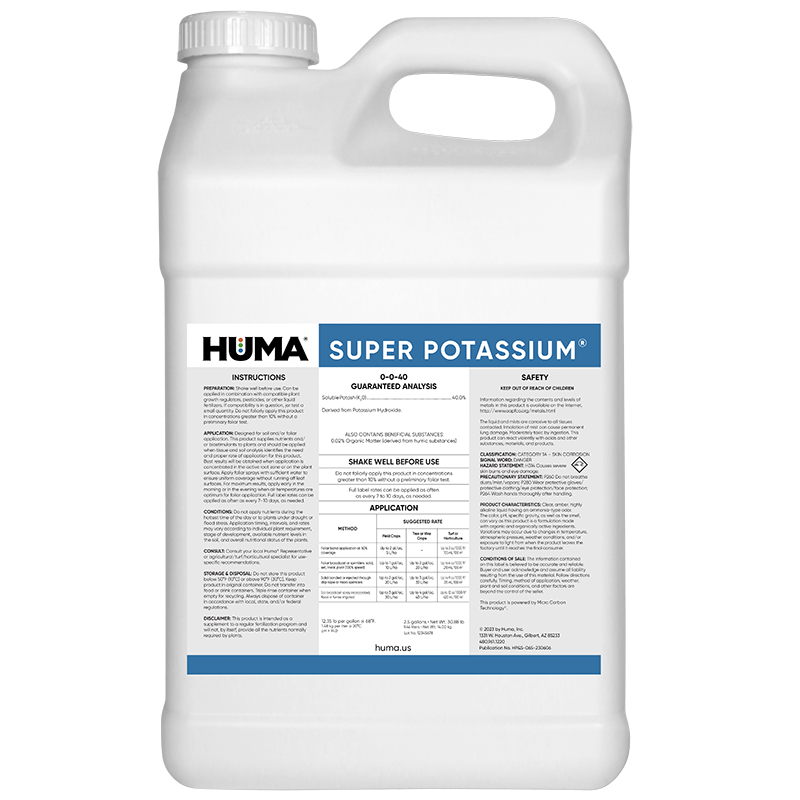
SUPER POTASSIUM
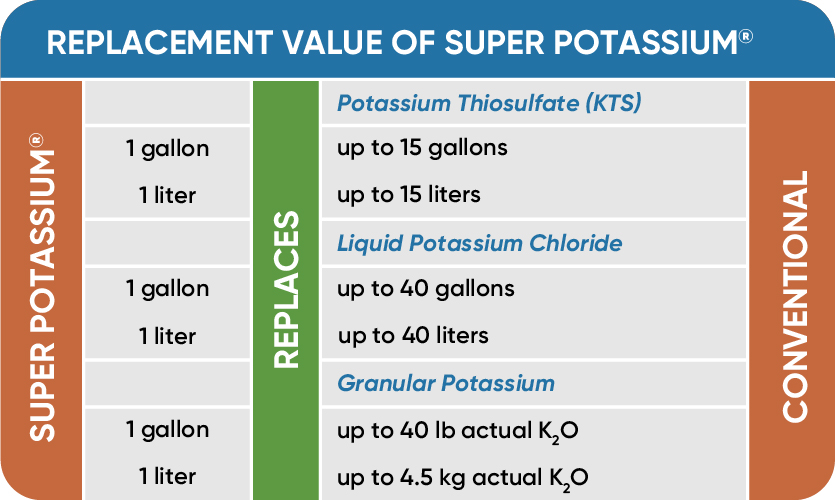
Benefits of Use:
- Resists tie-up in the soil and remains available through the plant root system
- Provides quick crop response and can be applied just prior to actual crop need
- Can be tank-mixed to improve availability of other potassium solutions
- Is non-salt-forming and does not contain chloride
- Aids in potassium uptake in heavy clay, compacted, or high-salinity soils
- Can be mixed with nitrogen solutions for easy application
- Is completely water soluble and can be water incorporated
Deficiency Symptoms—When to Apply:
- Tip and marginal “burn” starting on more mature leaves
- Weak stalks: plants lodge easily
- Small fruit or shriveled seeds
- Slow growth
FAQs
Related Videos
Mixing Liquid Humic Acid with Agrochemicals
This video demonstrates how to mix liquid humic acids, such as Huma Pro® 16, with liquid fertilizers without creating precipitation that can gum up spray or irrigation equipment.
Learn More
Super Potassium® Efficiency with Jason Felton
Watch our video on Super Potassium® Efficiency with Jason Felton
Learn More
Trials on Cotton in Turkey
Watch our video on Cotton Trials in Turkey
Learn More
Related Case Studies

Super Potassium on Cotton
Background: Farmers who try to supply K2O needs on the farm don’t have too many options to get K into the plant, especially in deficient soils. A typical application is KCl which contains an excess amount of Chloride which may not be beneficial to the plant and soil microbes. Huma’s Micro Carbon Technology® based Super

Huma® and Zia Pueblo Farm Corn Project
Background Many small-scale farms (1-2 acres each) are established in Zia Pueblo community near San Ysidro, New Mexico. Huma® Inc. was asked to establish an experimental farm in the tribal community that could demonstrate the usage of beneficial agricultural inputs producing high-yield crop and preserving the health of the soil. Huma® humic-based products stimulate plant

Recoverable Sugar of Sugar Beets Yield Increased Using Huma® Program, Year 2
Objective This field trial was conducted to observe effectiveness of additional preharvest applications of Huma® products on recoverable sugar of sugar beets and return on investment. Materials & Methods This trial on sugar beet (Beta vulgais vulg. altissima) was conducted in Homedale, Idaho. The crop was seeded on April 18 and was harvested on October


Related Blog Posts

This Week in Ag #63
“Plants sure know the difference between rainwater and hose water.” That was my wife’s observation Saturday morning, after seeing the rapid overnight growth, beautiful green color, and new blooms from our garden plants, following a thunderstorm that brought a half-inch of rain.

Organic Fertilizer Success—45 Years in the Making
The creation of Fertilgold® Organics was a journey 45 years in the making that grew from a desire to contribute to a shared world abundance through our traditions and time-tested values. We have set a new standard for organic fertilizers.

The Immortal Words of a Corn Legend
"Any corn plant that doesn’t emerge within 12 hours of others is a weed.” Immortal words from an immortal farmer. My friend Steve Albracht. The brash Texan certainly had a way with words. And with corn. I called him the Ric Flair of corn growers – he held as many National Corn Growers Association (NCGA) yield contest titles as Flair has wrestling championships. And he was just as bold. Visiting his Hart, Texas, farm was akin to visiting that of Francis Childs or Roswell Garst. Fast, uniform crop emergence and singulation weren’t just a goal; it was his obsession. He wanted every plant in the entire field to emerge within eight hours. Studies show that plants emerging 24 hours later can lose up to 25% of their yield. While some corn hybrids may be called racehorses, they don’t close on each other like racehorses do. Slow emergers and runt plants will never catch up to early risers.
Related Products
SILI-MAX
SILI-MAX®, carbon-complexed with Micro Carbon Technology®, is a highly available source of silica, which is essential in grains and grasses...
OM BORON
Carbon-complexed with Micro Carbon Technology®, OMRI-Listed® OM BORON is an organic boron nutrient. It ensures maximum assimilation of boron, which...
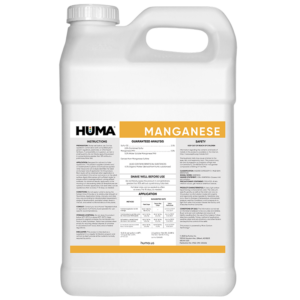
MANGANESE
Huma's MANGANESE, carbon-complexed with Micro Carbon Technology®, ensures efficient and effective uptake of manganese, which is a micronutrient involved in...