
ENCAPSALT
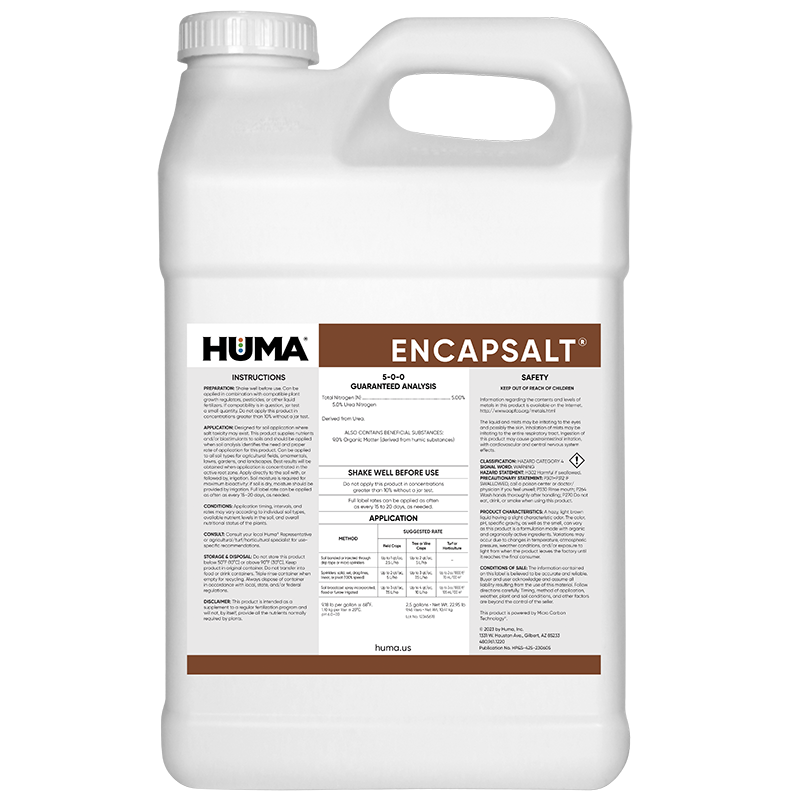
Benefits of Use:
- Buffers salts in highly alkaline or sodium-rich soils
- Improves the soil environment for aerobic biological activity
- Stimulates biomass development across all soil types
- Aerates soils and promotes clay flocculation
- Increases water penetration and infiltration
- Enhances nutrient availability for improved plant uptake
- Encourages root mass and deeper root penetration
Addresses the Following Problems:
- Anaerobic soil conditions
- Low soil organic matter
- Poor water penetration
- Salt damage or toxicity to plants
- Inhibited root growth, small root mass
How Encapsalt Works:
- ENCAPSALT frees sodium (Na) ions bound in the soil, allowing irrigation water to effectively leach excess salts deeper into the soil profile. This process improves water penetration and helps remediate crusted, compacted, and hard-setting soils.
FAQs
Related Case Studies

Huma® Improves Alfalfa Quality In the Southwest
Background All Huma® Inc. products are based on extractions of humic substances and other materials that can stimulate plant growth and improve crop quality. Objective The objective of this field trial was to evaluate the efficacy of applying Huma® products, specifically Encapsalt®, Super Phos®, Max Pak®, 44 Mag,® Vitol®, Super Nitro®, Breakout®, Fertil Soil®, Iro-Max®,
Huma® Improves Alfalfa Soil Biology In the Southwest
Background Industrial agriculture can degrade soil quality for crops by altering the total living microbial biomass of soil. Many practices and beneficial ag products have been introduced to the market to improve soil quality. Some of these products are humic substance-based products. Objective The objective of this trial was to evaluate the efficacy of applying
Related Blog Posts

From the Field: Why I Switched to MICROHUMIC® OM for Seed Lubrication
As a farmer and ag salesman at Huma, I’m always on the lookout for products that can make farming easier and more efficient. That’s how I first came across MICROHUMIC® OM at the 2024 Commodity Classic, right after I joined Huma. While working in our booth, I was chatting with our CEO, Lyndon Smith, when

How Advances in Crop Genetics Influence Nutrient Management
Advances in crop genetics are transforming how farmers approach nutrient management. Improved seed resilience, higher yield potential, and changing plant behaviors mean that fertility programs must evolve too. As genetics drive progress across the farm, understanding how nutrition supports those genetics is key to maximizing productivity and sustainability

This Week in Ag #63
“Plants sure know the difference between rainwater and hose water.” That was my wife’s observation Saturday morning, after seeing the rapid overnight growth, beautiful green color, and new blooms from our garden plants, following a thunderstorm that brought a half-inch of rain.
Related Products
MicroHumic OM
The Organic Solution for Stimulating Seeds, Soil, and Crops OMRI-Listed as both a soil amendment and as a seed treatment,...
SIL-K
SIL-K®, carbon-complexed with Micro Carbon Technology®, provides the potassium and silica essential in all crops for stronger fruit holding and...

OM LIQUID HA 16
Huma's OM LIQUID HA 16 is OMRI-Listed® for organic farming and carbon-complexed with Micro Carbon Technology®.