
FAQs
Related Products
MicroPlex® FL
Huma® MicroPlex® FL is a synergistic blend of preselected, adapted microorganisms and enzymes for use in facultative lagoons and ponds receiving...
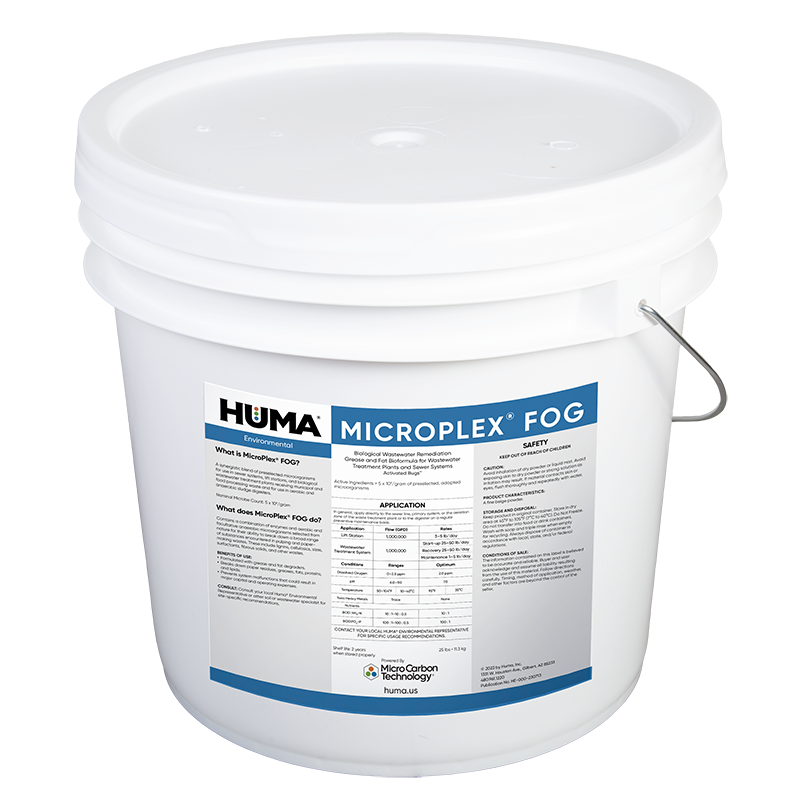
MICROPLEX FOG
Huma's MICROPLEX® FOG is a synergistic blend of preselected microorganisms for use in sewer systems, lift stations, and biological wastewater treatment plants...
MicroPlex® BP
Huma® MicroPlex® BP comes in rugged, submersible solid forms (cakes) that slowly dissolve in a flow stream and release safe, naturally...
Related Case Studies

Bio Genesis® Reduces Foam and Increases Stability at Arizona Municipal Wastewater Treatment Facility
Problem A municipal wastewater treatment facility in Arizona uses an activated sludge system with 4 oxidation ditches to treat approximately 9 million gallons per day. The system frequently experiences intermittent foaming and settling issues. The operator was looking for a solution to the foaming and settling issues that would also provide operational stability throughout the
Bio Energizer® Reduces Sludge at Small Municipal Facility
Problem A small town in Utah (pop. 1,800) had a municipal wastewater system with a flow rate of 192,000 gallons per day. The system included a series of four lagoons that tapered to a depth of 6 feet, although at this time only Ponds 1 and 2 were being evaluated for treatment as they were
Super Phos® Lowers Papermill Operating Costs in China
Problem The existing wastewater treatment system uses 600 kg/day of diammonium phosphate (DAP) to provide the needed phosphorus concentration to maintain a healthy microbial population to treat wastewater. These microorganisms break down the organic matter being discharged from the paper processing facility. Without the correct concentration of available phosphorus, the microorganisms are unable to grow
Related Blog Posts
Bio Energizer, Micatrol & Bio Feed Reduce COD and Stabilize Wastewater Treatment for Plastic Producer
A plastic manufacturer in Taiwan needed a new process to efficiently treat elevated incoming chemical oxygen demand (COD) to comply with stringent EPA regulations for effluent discharge. The plant is an activated sludge treatment system with an influent of approximately 2,000 cubic meters per day (CMD) which is equivalent to approximately 530,000 gallons per day

The Impact of Commonly Abused and Illicit Drugs in Wastewater Treatment
By Heather Jennings, PE, Senior Project Engineer for Probiotic Solutions® I was attending a wastewater conference and overheard an operator talking about how a drug bust turned his lagoon orange and almost put him out of compliance with his permit. At another location, I was told that the city I was visiting had been hit by

California Approves First 8 Fertilgold Products for CDFA-OIM Status
The California Department of Food & Agriculture (CDFA) has registered 8 Fertilgold® Organics products as Organic Input Materials (OIM) that can be sold in the state. Those products include the following: secondary macronutrients Fertilgold® Ca and Fertilgold® Mg, and micronutrients Fertilgold® B, Fertilgold® Co, Fertilgold® Mo, Fertilgold® MoN, Fertilgold® Zn, and Fertilgold® Micros I (which