
TURFPLEX IV
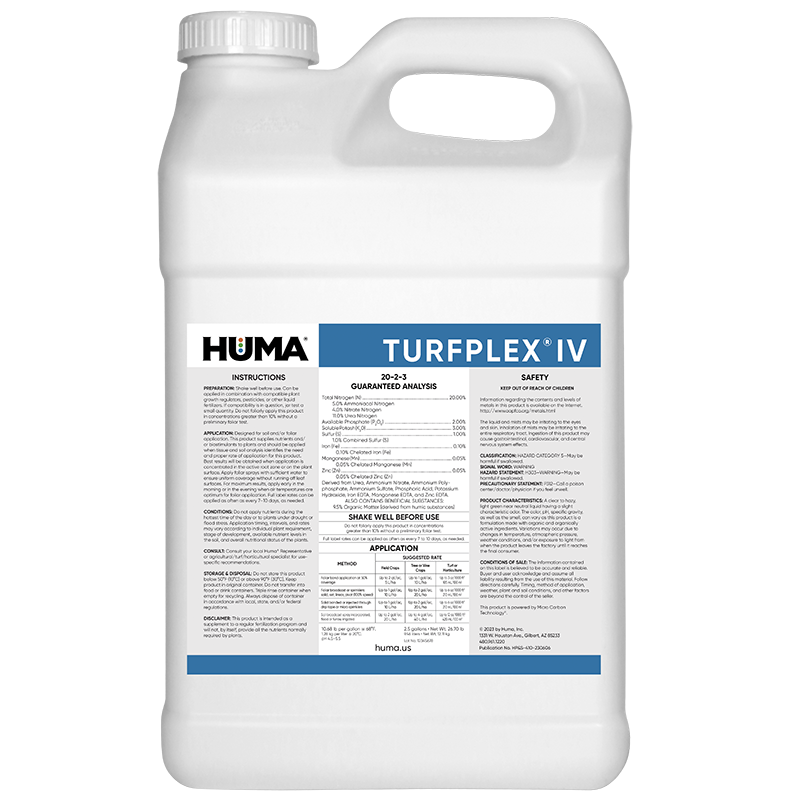
Benefits of Use:
- More consistent and sustained turf color and texture
- Increased stress tolerance
- More efficient nutrient uptake without leaf burn
- Better stimulation of root growth in seedlings and transplants
Deficiency Symptoms—When to Apply:
- Plant stress caused by nutrient deficiencies, insects, disease, weather, chemicals, or mechanical damage
- Leaf symptoms: Yellow-to-brown leaf edge, pale green leaves, leaf tips dying
- Root symptoms: Shallow rooting
FAQs
Related Products
BORON
Huma's BORON is carbon-complexed with Micro Carbon Technology®, ensures efficient and effective uptake of boron, which is required for cell...

OM SOIL ACTIVATOR
Carbon-complexed with Micro Carbon Technology®, OMRI-Listed® OM SOIL ACTIVATOR improves soil structure and enhances the beneficial soil microbial community. This...

OM CALCIUM
Carbon-complexed with Micro Carbon Technology® (MCT), OMRI-Listed® OM CALCIUM is an organic nitrogen-free calcium nutrient. Calcium is a required nutrient...
Related Case Studies
X-TEND Increases Soybean Yields
Background Huma’s X-TEND® has been applied to dry fertilizer and liquid blends to improve fertilizer effectiveness and to decrease nutrient losses. X-TEND may also be utilized to treat the soil and the plants directly to improve nutrient use efficiency, and act as a biostimulant to improve plant growth, and ultimately look at an increase in

Huma® Zap® Improves Corn Yield by 8.3 bu/A, With 10% ROI
Background Application of Zap® to soils in combination with other Huma® fertilizers at various locations previously resulted in crops with improved plant growth and higher yields. Applying Zap® with grower standard products or as a single product application to soil and plants could also impact results. Objective The focus of this study was to observe
Fertil Humus® Soil Amendment Trial for Water Infiltration
Objective This field trial assessed the benefits of moisture infiltration enhancement that may be provided by the product Fertil Humus® at selected rates and timings. Materials & Methods The plot site selected for this trial was located in the southern portion of the Columbia Basin in Washington State. The Russet Burbank potato field was pivot-irrigated




Related Blog Posts

This Week in Ag #10
Football may be a game of inches, but farming is a business of fractional inches. Take planting. Seed placement is paramount to the success of a crop. Farmers spend lots of time calculating the optimum rate and depth to plant their seeds based on genetics, soil type, soil conditions, weather, management practices and the desired output

The Huma Gro Farmer Podcast: Episode 9—Growing Premium Corn – Blog
This Week In Ag #92
Should regenerative agriculture resemble a Chinese menu, where you freely pick and choose the ingredients you want to include or eliminate from your entrée, rather than taking a holistic approach? That depends on your perspective of regen farming.