
Super Phos (HE)
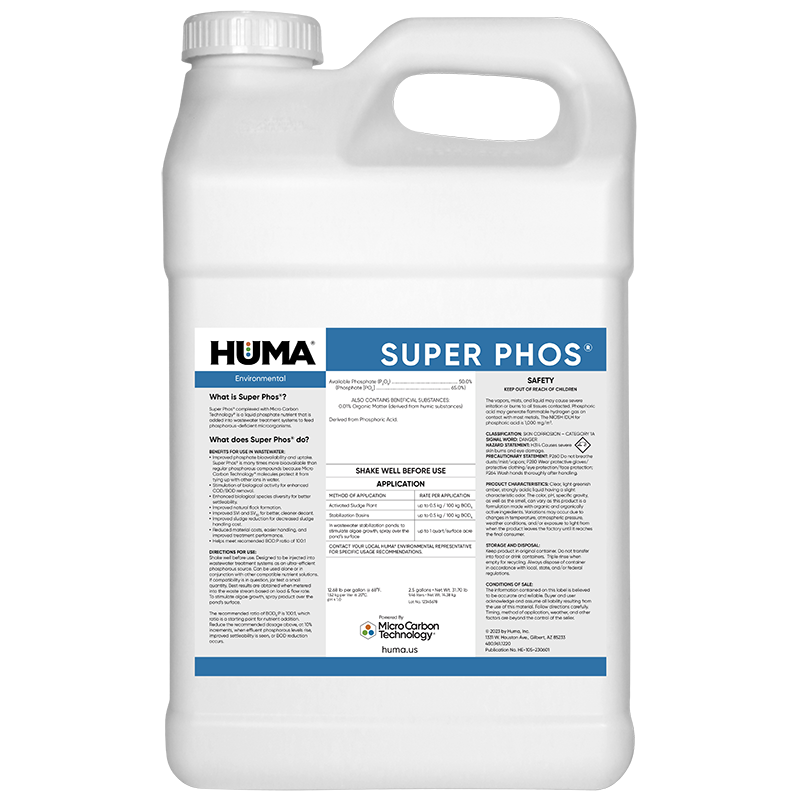
Benefits of Use:
- Helps to meet BOD:P ratio of 100:1
- Improved phosphate bioavailability and uptake. Super Phos® is many times more bioavailable than regular phosphorous compounds because Micro Carbon Technology® molecules protect it from tying up with other ions in water.
- Stimulation of biological activity for enhanced COD/BOD removal.
- Enhanced biological species diversity for better settleability.
- Improved natural floc formation.
- Improved SVI and SV30 for better, cleaner decant.
- Decreased phosphate levels in the effluent stream. Because Super Phos® is more bioavailable less phosphorus is applied, resulting in lower discharges. Typically, one-fourth to one-tenth the amount of Super Phos® is used when compared with common-grade phosphoric acid nutrients.
- Reduced material costs, easier handling, and improved treatment performance.
Problem Conditions Improved:
- Formation of insoluble phosphorous precipitates
- Foaming caused by filamentous bacteria
- Excess sludge production
- Excess phosphorus levels in effluent
- Settleability concerns
- Tankage/Storage concerns
FAQs
Related Case Studies

Super Phos® Lowers Papermill Operating Costs in China
Problem The existing wastewater treatment system uses 600 kg/day of diammonium phosphate (DAP) to provide the needed phosphorus concentration to maintain a healthy microbial population to treat wastewater. These microorganisms break down the organic matter being discharged from the paper processing facility. Without the correct concentration of available phosphorus, the microorganisms are unable to grow
Related Blog Posts

Water Master Plans
By Heather Jennings, PE When I worked with engineering firms, there were a lot of water master plans being developed. Many of them were updates, as the plans had been around for 5–10 years and needed revision. Some master plans evaluated water and wastewater systems from scratch. All of these were interesting to me due

Welcome to Huma®: Humic Solutions with a Human Touch
I am extremely proud to officially unveil our company’s new branding and name. We are now Huma®– a 50-year-old legacy ready to be reintroduced to the world! It is a strategic decision to shorten our name from Bio Huma Netics® (BHN) to Huma® and we are confident that this progressive move is in our company
Heather Jennings Is Featured Guest on “Better Together” Podcast
Paper360, a bimonthly magazine for the pulp & paper industry, produces a podcast called “Better Together: Conversations With Innovative Leaders.” At a recent podcast recorded live at SuperCorrExpo in Orlando, Fla., Heather Jennings, Director of Probiotic Solutions and Host of our own Water Break Podcast, was interviewed on the topic of diversity and innovation for
Related Products
Carbon-CH™
The Solution for Denitrification and Phosphorus Removal In Wastewater and Contaminated Soils Huma® Carbon-CH™ complexed with Micro Carbon Technology® is an activated...
Encapsalt® (HE)
Huma® Encapsalt® is a soil activator combined with surfactants based in and delivered by Micro Carbon Technology® that help sequester and...
FULVI PRO (HE)
FULVI PRO®, complexed with Micro Carbon Technology® (MCT), is an activated liquid fulvic acid carbon source derived from a highly...