
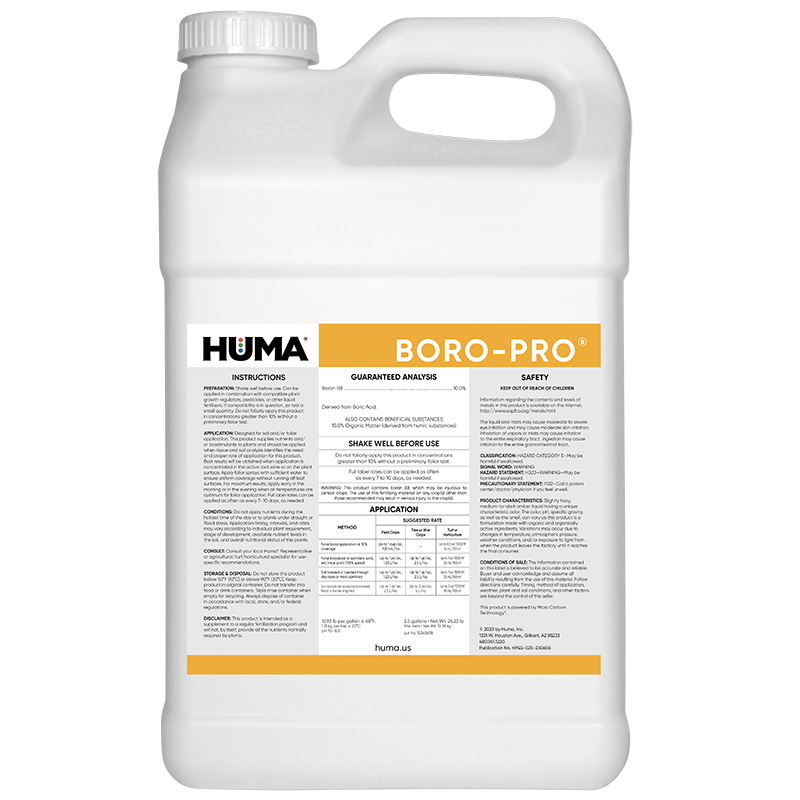
BORO-PRO
Benefits of Use:
- Supplies boron nutrition necessary for metabolic activity, proper growth, and maturation
- Enhances pollen viability and pollination in flowering crops
- Improves quality of crop
- Is required for cell division and normal tissue differentiation and maturation
- Functions with calcium to form an “intercellular cement” to maintain plant structuralintegrity
- Improves protein metabolism and reduces nitrate accumulation in young leaves
- Improves sugar transport in plants
Deficiency Symptoms—When to Apply:
- Reduced flowering or improper pollination
- Stubby stem or root growth; weakened cell walls that allow crop lodging
- Thickened, curled, wilted, and chlorotic leaves
- Symptoms of calcium deficiency may appear
- ALFALFA: yellow-reddish leaves in new growth, CORN: pollen tube failure, COTTON: rosette, NUT CROPS: decreased yields in otherwise-healthy trees
To add zinc to a boron application, Z-Max® can be mixed with Boro-Pro® when both are properly diluted.
FAQs
Related Videos
Huma® Micronutrients and Secondary Macronutrients
Huma liquid micronutrient and secondary macronutrient fertilizers with Micro Carbon Technology (MCT) are extremely efficient. MCT improves nutrient uptake so you can get the most out of your crops. Deliver micronutrients and secondary macronutrients exactly
Learn More
Related Case Studies

X-Tend® B With Micro Carbon Technology® Improves Barley Yield and Net Income: Year 3
Background Enhanced Efficiency Fertilizer (EEF) additives can improve crop production. Humates have been shown to improve crop yield. The Huma® EEF additive X-Tend® B is a concentrated Micro Carbon Technology® product derived from humates with high levels of organic acids and nutrients that is formulated to be blended in liquid fertilizers or to be impregnated

Recoverable Sugar of Sugar Beets Yield Increased Using Huma® Program, Year 2
Objective This field trial was conducted to observe effectiveness of additional preharvest applications of Huma® products on recoverable sugar of sugar beets and return on investment. Materials & Methods This trial on sugar beet (Beta vulgais vulg. altissima) was conducted in Homedale, Idaho. The crop was seeded on April 18 and was harvested on October

Zap® Improves Soil Biology and Soil Structure
Objective Huma® Zap® has been shown to improve crop yield and soil conditions. This research investigated some of the ways Zap improves soil characteristics such as soil biology and soil structure. Materials & Methods Two sets of soil in containers received two different solutions. The first received 120 ml of only water and the second





Related Blog Posts

This Week In Ag #101
Ask yourself this. Would you really want to be on the other side of a trade dispute with the USA? With all the hysteria over tariffs, that’s a question few seem to be asking. In the global economy, the good ole USA remains the 700-pound gorilla. Boasting a GDP over $25 trillion, the US economy is nearly

Strengthening the Biostimulant Movement with HPTA
By Lyndon SmithPresident and CEO,Bio Huma Netics, Inc. We attended the Humic Products Trade Association (HPTA) annual meeting this past month in Park City, Utah. It’s always a pleasure to get together with industry peers and talk about issues pertaining to HPTA as well as discussing the latest and the greatest research and product developments
This Week In Ag #99
Shopping with a farmer can be quite the experience. It’s one my mother refused to partake in during her entire 40-year marriage. This weekend, I went with my wife to exchange a pair of blue jeans that Santa brought me. As we were looking for my size, a clerk at Boot Barn suggested a different
Related Products
CROP-GARD
CROP-GARD®, carbon-complexed with Micro Carbon Technology®, provides nutrients and refined plant oils for natural plant vigor. CROP-GARD also achieves balanced...

OM CALCIUM
Carbon-complexed with Micro Carbon Technology® (MCT), OMRI-Listed® OM CALCIUM is an organic nitrogen-free calcium nutrient. Calcium is a required nutrient...
TURFPLEX IV
Huma's TURFPLEX® IV is a well-rounded formulation of complexed macro and micronutrients designed to promote lush, green growth in turf...