
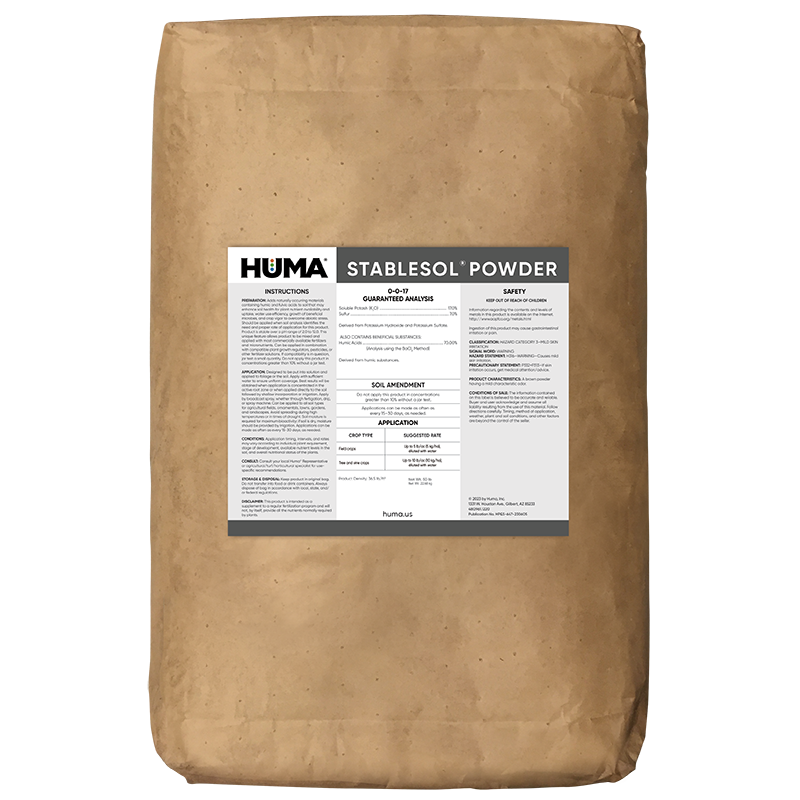
STABLESOL POWDER
Benefits of Use:
- Uniform 95% soluble powder promotes even coverage/distribution of humic substances for sustainable carbon benefit
- Short-term soil organic-matter building
- Promotes conversion of fertilizer into plant-available food
- Increases nutrient mineralization
- Sustainable soil microbial activation
FAQs
The Smarter Way to Deliver Humic Benefits
STABLESOL® POWDER is a water soluble powder produced using a proprietary extraction, modification, and spray dry process. This process yields a high humic substance product that, when added to water or other nutrient solutions, has a low solution viscosity. This product can be blended and pumped easily and will not plug nozzles or gel during storage. Huma’s STABLESOL POWDER has excellent stability under both high and low soil pH conditions. It is highly effective for complexing metal ions and for preparing micronutrient solutions at various pH ranges (2.0–12.0). As both an alkaline and acid soluble potassium humate, this product is truly unique. It completely dissolves and will not precipitate when added to other nutrient solutions.
GUARANTEED ANALYSIS
0-0-17
Soluble Potash (K2O)………………………………….17.0%
Sulfur (S)…………………………………………………………. 7.0%
Derived from: Potassium Hydroxide and Potassium Sulfate
Also contains beneficial substances:
Humic Acids……………………………………………… 70.0%
(Analysis using the BaCl2 Method)
Derived from: Leonardite
PHYSICAL PROPERTIES
Form: Powder
Appearance: Brown powder having a mild characteristic odor.
Product Density: 36.5 lb/ft3
Net Weight: 55 lb / 25 kg
25 kg. Paper Kraft Bagging – Our 25 kg. bags are “blow-in” type bags with 2 paper layers and an inner layer of impermeable plastic. Air holes in the bags allow the product to be blown in through an opening in the top of the bag. This opening is self-closing when the bag is filled to capacity. 25 kg. bags are stacked on 40×48″ pallets for shipping, with 40 bags to the pallet (2,000 pounds of product per pallet. The pallets themselves weigh 50 pounds). Shrink wrapping of palleted bags is available upon request. The bags are a plain brown paper with no printing. Pre-printed customer bags can be filled upon request.
1 Ton Mini Tote Bags – The most popular method for shipping our products is in mini-bulk bags, each of which holds approximately 1 ton of product. These bags are made of a synthetic material and are resistant to moisture. The bags are “duffel top”, meaning they can be tied closed at the top. A spout on the bottom of the mini-bulk bags is tied closed for filling and can be opened to allow dumping of the product into a hopper or mixer. Straps at the four top corners of the bags allow easy handling with a forklift. We can ship mini-bulk bags on pallets (36×26″) upon request.

Soluble Powder Application Rates Chart
Related Videos
Huma Minute – What is Humic Acid with Cory Ritter
Huma Mid-West Regional Sales Manager Cory Ritter discusses the different types of humic acids and what they do for your plants.
Learn More
Huma Minute – Humate Application Rates with Cory Ritter
Huma Mid-West Regional Sales Manager Cory Ritter discusses humate application rates and why there is not a one-size fits all rate.
Learn More
Huma Minute – Humic Acid Testing Methods with Cory Ritter
Huma Mid-West Regional Sales Manager Cory Ritter discusses the differences in the various humic acid testing methods.
Learn More
Related Case Studies

Humic Products Increase Iowa Corn Yield
Background Scientific research shows humic and fulvic acids can have a biostimulant effect on plant root growth and mass, nutrient availability and uptake, and crop yield and quality. Objective The objective of this study was to compare and contrast the immediate effects that three types of humic products from Huma®, Inc. have on corn yield.

X-Tend® B With Micro Carbon Technology® Improves Barley Yield With an ROI of 38:1
Objective Determine the effect on barley of adding Huma® X-Tend® B to split applications of different rates of nitrogen fertilizer. Background Enhanced Efficiency Fertilizer (EEF) additives improve crop production. Humates have been shown to improve crop yield. The Huma® EEF additive X-Tend® B is a concentrated Micro Carbon Technology® product with high levels of organic
Huma® OM Soil Activator Increases Corn Yield 19%, With 240% ROI
Background In an earlier in-house research project, it was observed that OM Soil Activator (formerly known as Fertilgold® Soil) caused plants to grow better and improve soil characteristics. The product was then released for field trial status. Objective The focus of this study was to observe if Huma® OM Soil Activator, an OMRI-Listed product for


Related Blog Posts

The World’s Weather Is Your Market
Europe's record-breaking heat is shrinking grain production and driving prices higher, but global weather isn't the only story. As drought expands across parts of the U.S., the weeks ahead will be critical for crop development—and grain markets.

How the “Three Sisters” Fed a New World
Discover how the Native American “Three Sisters” farming system, corn, beans, and squash, created a powerful, regenerative growing method that helped feed the New World and shaped sustainable agriculture long before modern science.

Back to ’72: My First Farm Progress Show
In 1972, the Farm Progress Show came to my hometown of Galesburg, Illinois and even to the farm of my family’s closest friends. That year’s show was the biggest in history, drawing over 360,000 people and marking the dawn of U.S. farming’s golden age. Looking back, it was a front-row seat to agriculture’s past, present, and future.
Related Products

PROUD 4
PROUD 4® is an OMRI-Listed® crop protection product. It is a broad-spectrum insecticide, nematicide, miticide, and fungicide with on-contact and...
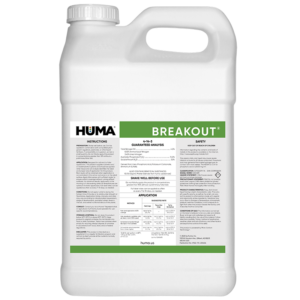
BREAKOUT
BREAKOUT®, carbon-complexed with Micro Carbon Technology®, is designed to feed the natural metabolic process within the plant for enhanced bud...

OM LIQUID HA 16
Huma's OM LIQUID HA 16 is OMRI-Listed® for organic farming and carbon-complexed with Micro Carbon Technology®.