
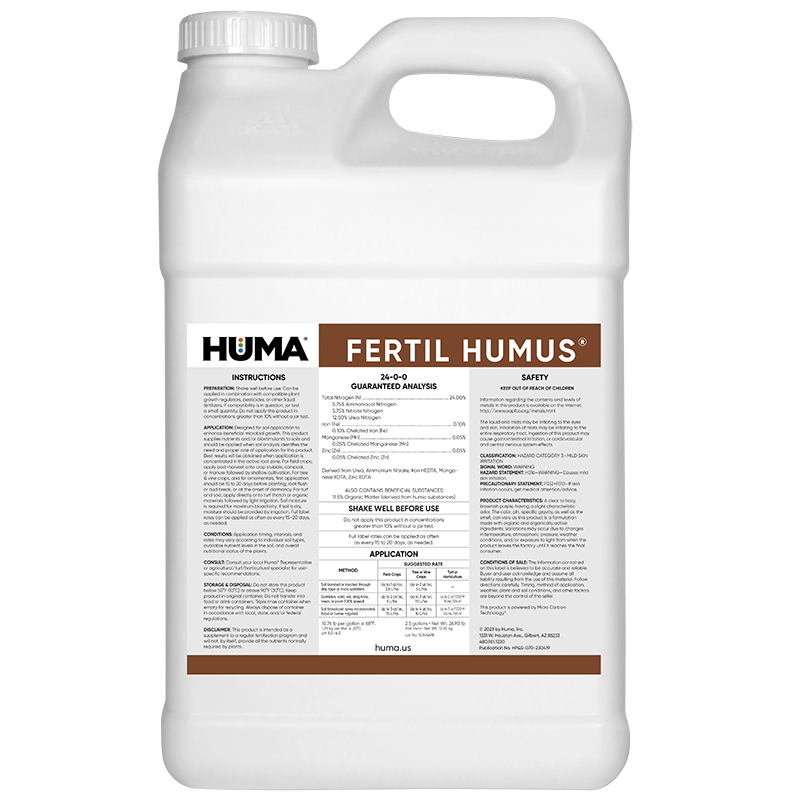
FERTIL HUMUS
Benefits of Use:
- Promotes decomposition of organic residues in soil
- Enhances nutrient recycling from organic matter
- Improves overall soil health and structure
- Buffers harsh chemicals and helps break down soil toxins
- Increases soil water retention
- Stimulates healthy root growth
Deficiency Symptoms—When to Apply:
- Poor or imbalanced soil biology
- Slow decomposition of organic matter
- Sandy soils in need of stabilization through humus formation
- Poor water infiltration or retention
- Presence of chemical residues or soil toxins
FAQs
Related Videos
Huma Gro® Agricultural Products Increase Crop Yield in Mid-South US
Huma Gro® fertilizers and crop treatments increase harvest and profit, control soil salinity, and manage crop disease worldwide. Unlike other farm products, Huma Gro® farming products with Micro Carbon Technology® are more efficient. Huma Gro®
Learn More
Huma Fertil Humus: Soil Fertility Product
A 24-0-0 liquid fertilizer for building soil humus. Aids in the decomposition of organic materials in the soil. Increase soil water retention and buffer plants from chemical residue in the soil
Learn More
Related Case Studies

Fall Soil Application of Fertil Humus® Increases Illinois Corn Yield and ROI
Background Feeding beneficial soil fungal activity can enhance aerobic decomposition of organic matter and build a humus-rich soil that releases nutrients tied up in crop residues. This can positively impact crop yield and lead to a higher return on investment. Objective The objective of this study was to observe how a fall application of Huma®

Effects of Huma® Products on N & P Stabilization in Sandy Soil
Objective To demonstrate the effects of Huma® products X-Tend®, Fertil Humus®, Fertil Soil®, and Zap® on the reduction of nitrogen and phosphorus leaching in Immokalee sandy soils. Background The leaching of nitrogen and phosphate fertilizers presents an ongoing problem in Florida soils. Agricultural amendments that reduce leaching when applied to soils or when mixed with

Fertil Humus® Soil Amendment Trial for Water Infiltration
Objective This field trial assessed the benefits of moisture infiltration enhancement that may be provided by the product Fertil Humus® at selected rates and timings. Materials & Methods The plot site selected for this trial was located in the southern portion of the Columbia Basin in Washington State. The Russet Burbank potato field was pivot-irrigated
Related Blog Posts

This Week in Ag #20
Wheat harvest is well underway throughout the country. Each morning, the harvest process begins with equipment maintenance. Most farmers and custom cutters will park their fleet in a row, or in close proximity, so they can readily perform daily service. This involves the grease gun. Combines have hundreds of moving parts. Some of the most key

Huma Gro® Fertilizer Products Increase Cucumber Yields at ROI of 113%
The Huma Gro® fertilizer treatment increased the cucumber yield by 2% (8 bushels per acre) over the Check, with a return on investment (ROI) of 113%.

When Winter Hits the Herd
Arctic cold swept much of the country this winter, prompting warnings to bring pets indoors. But cattle don’t get snow days. Built with an internal furnace and guided by generations of husbandry wisdom, ranchers and their herds weather the cold together—fed, watered, dry, and checked no matter the conditions.
Related Products
OM 2-6 mm
Huma's OM 2–6 mm is a natural humic and fulvic acid product processed from naturally occurring, oxidized humic substances. It provides...
OM POTASSIUM
Carbon-complexed with Micro Carbon Technology®, OMRI-Listed® OM POTASSIUM is an organic potassium product that effectively maximizes potassium uptake by plants....
MANGANESE
Huma's MANGANESE, carbon-complexed with Micro Carbon Technology®, ensures efficient and effective uptake of manganese, which is a micronutrient involved in...