
OM 6 mm(-)
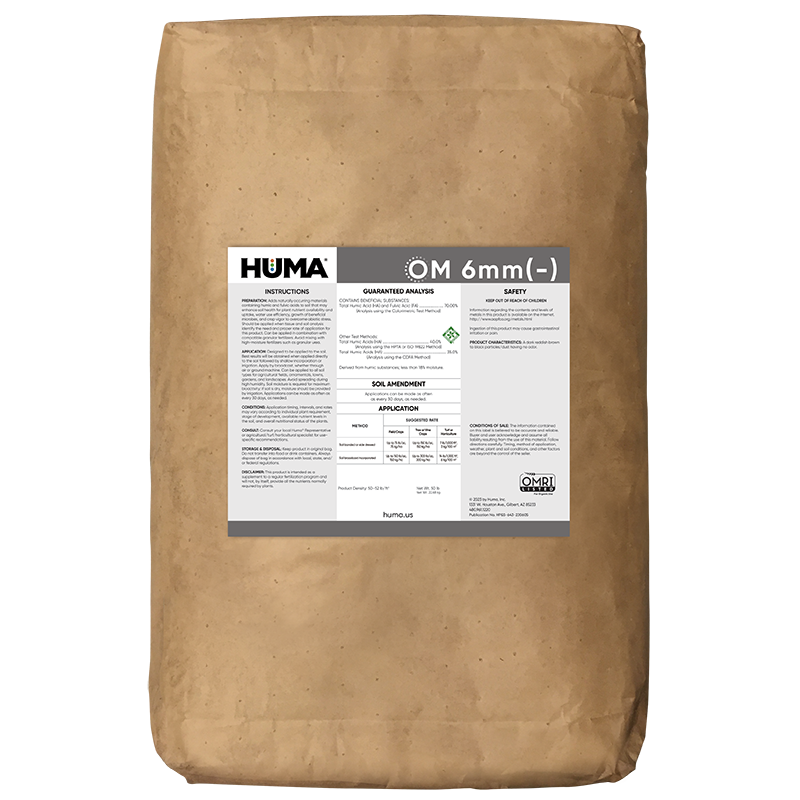
Benefits of Use:
- Variable granular size promotes even coverage/distribution of humic/fulvic acid for sustainable carbon benefit
- Long-term soil organic-matter building
- Increased water penetration
- Increased flocculation of clays
- Promotes conversion of fertilizer into plant-available food
- Increases soil nutrient mineralization
- Sustainable soil microbial activation
FAQs
Related Videos
Huma Minute – What is Humic Acid with Cory Ritter
Huma Mid-West Regional Sales Manager Cory Ritter discusses the different types of humic acids and what they do for your plants.
Learn More
Huma Minute – Humate Application Rates with Cory Ritter
Huma Mid-West Regional Sales Manager Cory Ritter discusses humate application rates and why there is not a one-size fits all rate.
Learn More
Huma Minute – Humic Acid Testing Methods with Cory Ritter
Huma Mid-West Regional Sales Manager Cory Ritter discusses the differences in the various humic acid testing methods.
Learn More
Related Products
OM POTASSIUM
Carbon-complexed with Micro Carbon Technology®, OMRI-Listed® OM POTASSIUM is an organic potassium product that effectively maximizes potassium uptake by plants....
IRO-MAX
IRO_MAX®, carbon-complexed with Micro Carbon Technology®, provides effective and quick iron uptake into the plant. Iron is a key micronutrient...
SULFUR
Huma's SULFUR, carbon-complexed with Micro Carbon Technology®®, enables sulfur nutrient absorption by the plant. SULFUR is a major nutrient involved...
Related Case Studies

PROUD 3 Fungicide Replacement
Background Huma® fungicide programs with Micro Carbon Technology® provide growers with effective options that can replace synthetic fungicides with a more sustainable and environmentally friendly approach, while providing excellent control and improving crop health, yield and quality. Objective The focus of this study was to assess if 2 of Huma’s products CROP-GARD® (Growth Manager) and

Humic Products Increase Soybean Yield In Iowa
Background Scientific research shows humic and fulvic acids can have a biostimulant effect on plant root growth and mass, nutrient availability and uptake, and crop yield and quality. Objective The objective of this study was to compare and contrast the immediate effects that three types of humic products from Huma®, Inc., have on soybean yield.
Huma Pro® Mix, pH-Stable Liquid Humic Acid Product, Increases Corn Yield
Conducted by: Bruce Kirksey, PhD, Agricenter International, Memphis, Tenn. Huma® Product: Huma Pro® Mix Background Scientific research shows that humic and fulvic acids are biostimulants—enhancing nutrient availability and uptake, improving plant root growth and mass, and impacting both crop yield and quality. Humic acid products are not all the same. They are marketed in solid




Related Blog Posts

This Week In Ag #97
New Year’s babies bring a renewed spirit of hope to those whose lives they touch. On January 1, 1865, a baby born in Diamond, Missouri, not only brought hope, but salvation to US agriculture. His name was George Washington Carver.

This Week In Ag #103: Short-Term Pain, Long-Term Gain?
“There’s got to be a better way.” Those words were expressed to me last week at the World Ag Expo. I had just completed my presentation, “Breathe New Life into Your Soil”, when a nice lady and her husband approached me. She introduced herself as a multi-generational rancher who grows alfalfa and orchard grass for their

War Sends Shockwaves Through Farm Inputs
Global tensions are rippling through agriculture as fertilizer, fuel, and freight costs surge ahead of spring planting. With urea prices jumping and supply chains under pressure, farmers are once again facing rising input costs at the worst possible time.