
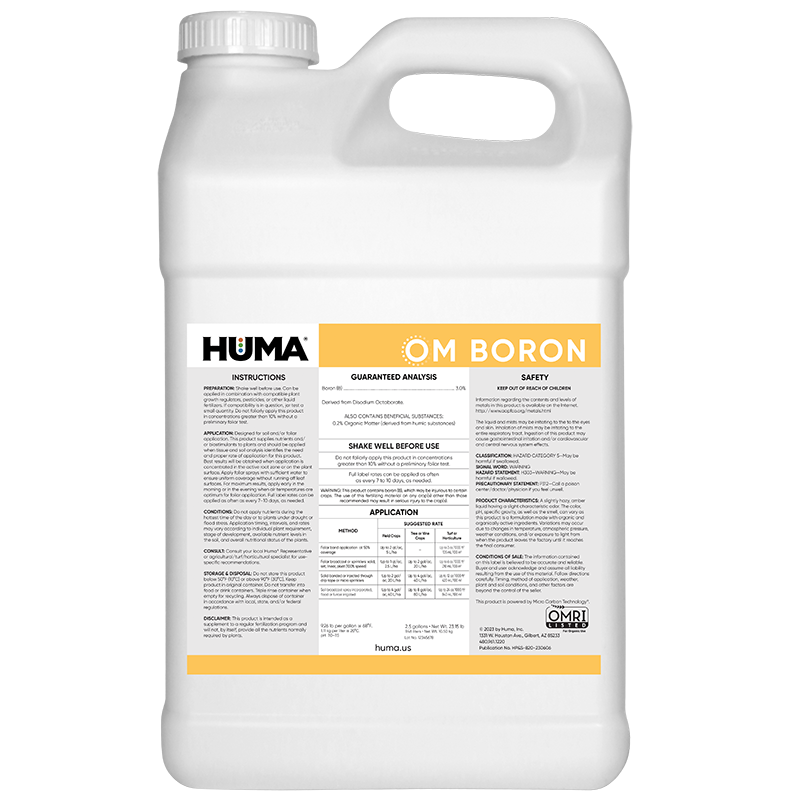
OM BORON
Benefits of Use:
- Effectively treats boron deficiency symptoms, supplying boron nutrition necessary for metabolic activity, proper growth, and maturation
- Functions with calcium to form an “intercellular cement” to maintain plant structural integrity
- Provides quick crop response and can be applied just prior to actual crop need
- Can be applied foliarly (according to label directions) without risk of phytotoxicity
- Can be effectively tank-mixed with other organic crop inputs
- Resists tie-up in the soil and remains available through the plant root system
FAQs
Related Products

COMOL
Huma's COMOL™, carbon-complexed with Micro Carbon Technology®, ensures efficient nutrient uptake and translocation of phosphorus, cobalt, and molybdenum, which indirectly...
ENCAPSALT®
ENCAPSALT® combines nutrients with surfactants based in a Micro Carbon Technology® base that helps diminish salt stress in the root...
BREAKOUT
BREAKOUT®, carbon-complexed with Micro Carbon Technology®, is designed to feed the natural metabolic process within the plant for enhanced bud...
Related Case Studies

Huma® Promax® and Zap® Decrease Charcoal Rot in Florida Strawberry, With Increased Yield and ROI of 10:1
Background Charcoal rot, caused by the soil-borne pathogen Macrophomina phaseolina, can be a significant threat to strawberry production. Two Huma® products, Promax® and Zap®, had previously been shown to be successful in managing soil-borne diseases in strawberries. Objectives The primary objectives of this study were to assess the efficacy of Promax® and Zap® in reducing

Super Potassium on Cotton
Background: Farmers who try to supply K2O needs on the farm don’t have too many options to get K into the plant, especially in deficient soils. A typical application is KCl which contains an excess amount of Chloride which may not be beneficial to the plant and soil microbes. Huma’s Micro Carbon Technology® based Super

One-Hour Tissue Absorption Study
Background When applying foliar sprays, it’s highly beneficial for crop nutrients to quickly enter the plant tissue. Farmers often have a short application window and need to make sure the nutrients get into the plant prior to rain Objective Observe how fast a foliar application of Huma® Super Potassium® (0-0-40), powered by Micro Carbon Technology®,




Related Blog Posts

This Week in Ag #58
Yesterday was the 110th birthday of the greatest agriculturalist of all time, Norman Borlaug. The Cresco, Iowa, native’s ground-breaking work to prevent hunger is said to have “saved more lives than any other person who ever lived.” That would be more than one billion lives, according to estimates.

Organic Fertilizer Success—45 Years in the Making
The creation of Fertilgold® Organics was a journey 45 years in the making that grew from a desire to contribute to a shared world abundance through our traditions and time-tested values. We have set a new standard for organic fertilizers.

This Week In Ag #101
Ask yourself this. Would you really want to be on the other side of a trade dispute with the USA? With all the hysteria over tariffs, that’s a question few seem to be asking. In the global economy, the good ole USA remains the 700-pound gorilla. Boasting a GDP over $25 trillion, the US economy is nearly