
Bio Energizer
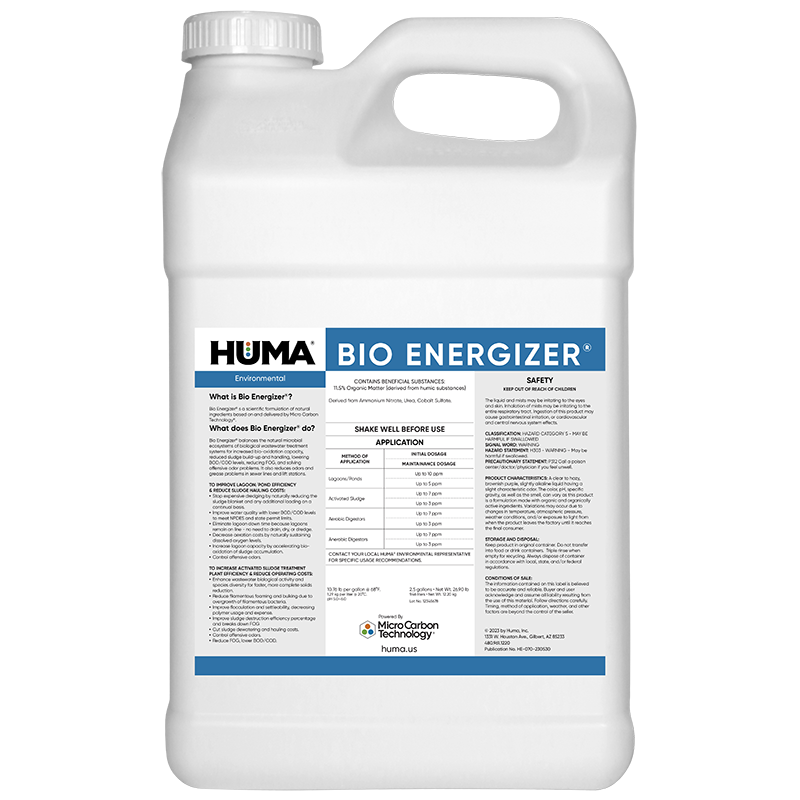
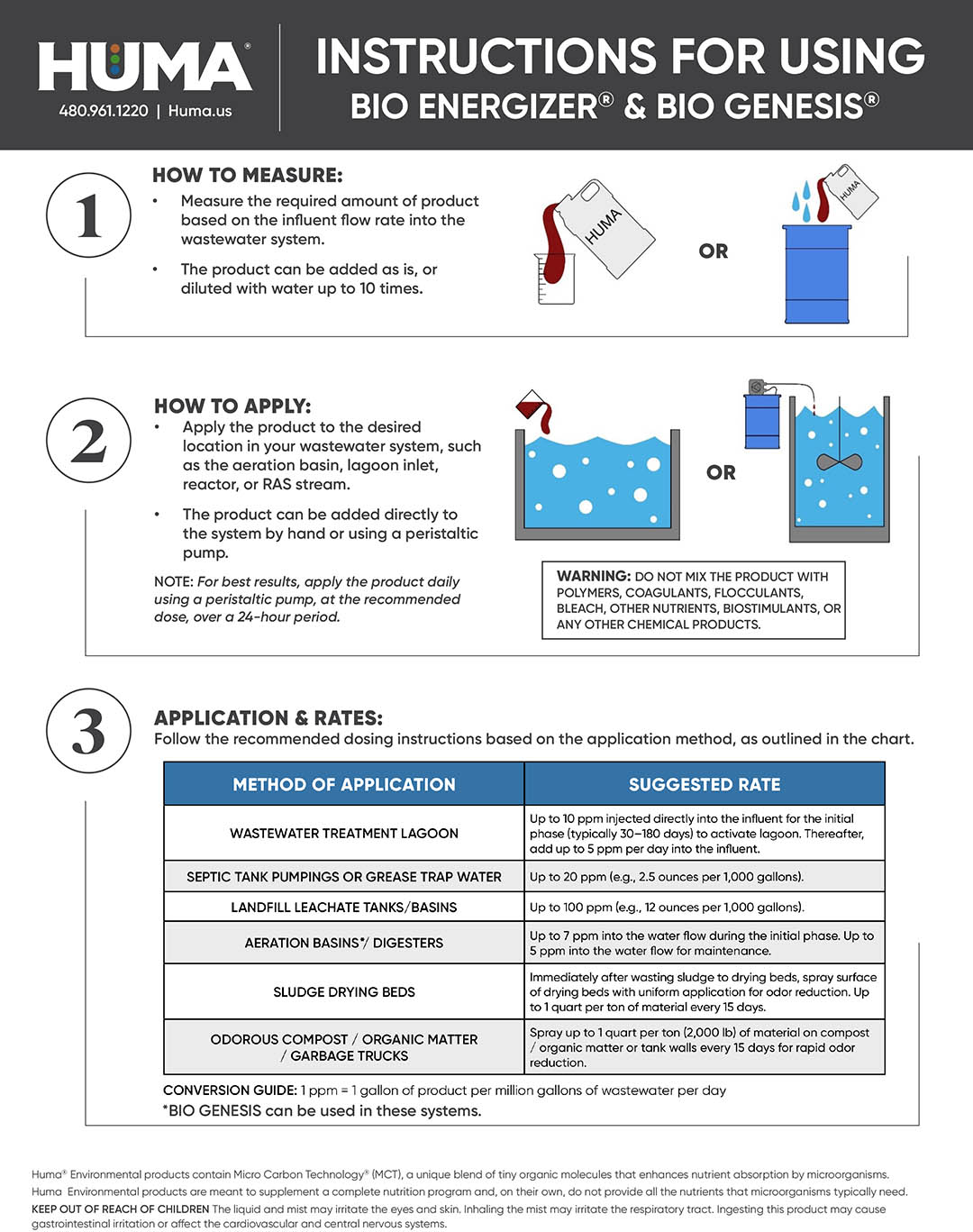
Benefits of Use:
- Reduces noxious odors
- Breaking down of fats and greases
- Drying beds dry faster
- Reduces sludge buildup in lagoons
- Sustains dissolved oxygen levels
- Decreases mechanical aeration and energy costs
- Speeds organic matter composting while improving quality
- Lowers sludge dewatering and hauling costs
- Reduces filamentous foaming and bulking
- Improves flocculation and settleability
- Minimizes upsets
- An economical alternative to mechanical sludge removal eliminating handling costs and out-of-service time
FAQs
Related Videos
Huma Environmental Bio Energizer Industrial
Huma Environmental Bio Energizer Industrial video
Learn More
Huma Environmental Wastewater Treatment Products
Huma Environmental wastewater treatment products are meant to work with all of the systems to proactive with biology. Our products stimulate the biology that is already present. A product line that stimulates what's already present
Learn More
Related Case Studies

Lagoon Study Shows Sludge Layer Biologically Active and Responsive to Reduction Using Bio Energizer®
Summary In this study, a one-year bioremediation plan was implemented for a municipal wastewater treatment facility with 2 primary lagoons that were at risk of upset and in which wastewater processing capacity was reduced due to an increased sludge layer. Specific changes in strata microbial life were tracked through ATP and DNA analysis at quarterly
Bio Energizer® Toxicity Testing
Abstract Bio Energizer® is frequently used to facilitate bioremediation of wastewater. A study was conducted by an independent laboratory to measure possible negative effects Bio Energizer® might have on a freshwater test species (rainbow trout). Using EPA-approved methodology to evaluate Bio Energizer®, the lab administered the product at 10 ppm to a test tank and
Bio Energizer® Reduces Sludge at Small Municipal Facility
Problem A small town in Utah (pop. 1,800) had a municipal wastewater system with a flow rate of 192,000 gallons per day. The system included a series of four lagoons that tapered to a depth of 6 feet, although at this time only Ponds 1 and 2 were being evaluated for treatment as they were
Related Blog Posts
The Water Break Podcast, Episode 26: Master Plans—A Vision for the Future
“Where We Bridge the Gap Between Water Plant Operators and Engineers” In The Water Break Podcast Episode 26, Heather Jennings, PE, discusses Water and Wastewater Facility Master Plans with guest Devan Shields, Project Engineer at Sunrise Engineering in Fillmore, Utah (phone 435.562.4086). Mr. Shields develops water and wastewater infrastructure solutions that include master plans, designs,

Introducing New Humic Conversations Video Series
We are excited to introduce our new educational project, the Humic Conversations Video Series. As the name suggests, each episode of the series will focus on humic substances. Two leading researchers from our Humic Research Lab. Dr. Rich Lamar and Dr. Hiarhi Monda will share their expertise with the viewers. In Episode 1 of this

California Approves First 8 Fertilgold Products for CDFA-OIM Status
The California Department of Food & Agriculture (CDFA) has registered 8 Fertilgold® Organics products as Organic Input Materials (OIM) that can be sold in the state. Those products include the following: secondary macronutrients Fertilgold® Ca and Fertilgold® Mg, and micronutrients Fertilgold® B, Fertilgold® Co, Fertilgold® Mo, Fertilgold® MoN, Fertilgold® Zn, and Fertilgold® Micros I (which
Related Products
Micatrol®
Huma® Micatrol® is a formulation of complexing agents, organic acids, buffers, nutrients, and energy systems that enhance biological degradation. Micatrol® catalyzes the...
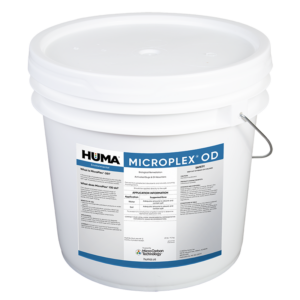
MICROPLEX OD
Huma's MICROPLEX® OD is a fine powder of preselected absorbents and naturally occurring microbial strains that is formulated for use on...
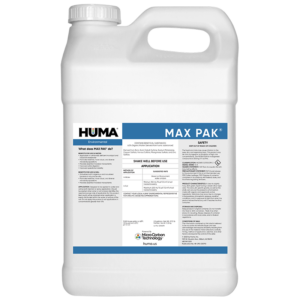
Max Pak® (HE)
Huma® Max Pak® is a liquid micronutrient formulation containing an organically complexed, highly stable source of many important micronutrients for a balanced...